
Procurement and logistics were traditionally managed by separate teams with different budgets, systems, and KPIs. That structure becomes less effective when a business relies on international suppliers, changing freight routes, strict delivery deadlines, and detailed sustainability data.
For brands sourcing branded merchandise, on-pack marketing materials, POSM, and custom products from Asia, procurement decisions directly affect production schedules, packaging, freight costs, customs requirements, and final delivery.
This article explains the difference between procurement and logistics, where their responsibilities overlap, and how businesses can build a more connected Asia sourcing process.
What Is the Difference Between Procurement and Logistics?
Procurement Manages Suppliers and Purchasing Decisions

Procurement covers the process of sourcing and acquiring the goods or services a business needs. It commonly includes:
- Defining product and commercial requirements
- Identifying and evaluating suppliers
- Managing RFQ and RFP processes
- Negotiating prices and contracts
- Approving samples
- Issuing purchase orders
- Managing supplier quality and performance
Its main focus is securing the right product, supplier, terms, quality, and overall commercial value. CIPS defines procurement as buying the goods and services an organisation needs to operate its supply chain profitably and ethically.
Logistics Manages the Movement and Storage of Goods
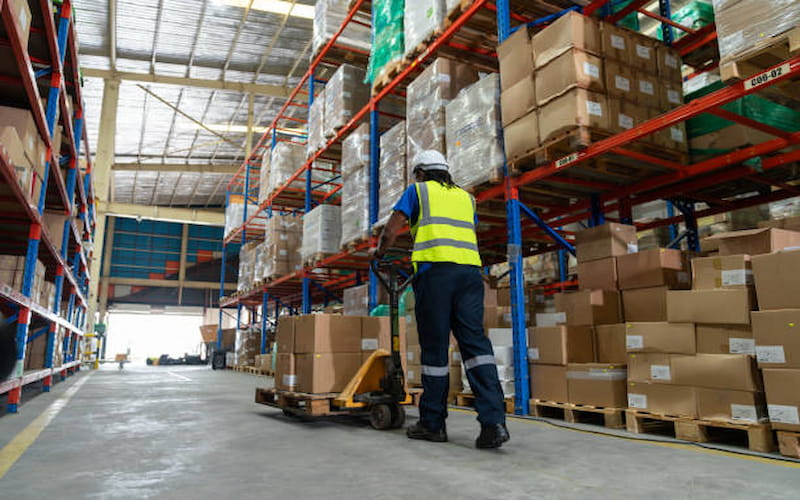
Logistics coordinates how goods move from the supplier through warehouses, customs, distribution centres, and final delivery locations.
It commonly includes:
- Freight planning and booking
- Warehousing
- Pick-and-pack fulfilment
- Transport documentation
- Customs coordination
- Shipment tracking
- Last-mile delivery
- Returns and reverse logistics
Its main focus is moving and storing goods efficiently while meeting cost, timing, and delivery requirements.
Procurement does not end when goods leave the factory, and logistics does not begin only after production. The functions overlap during supplier selection, production planning, packaging, Incoterm selection, freight preparation, and delivery scheduling.
How Do Procurement and Logistics Compare?
| Dimension | Procurement | Logistics |
| Primary focus | Sourcing, purchasing, contracts, and supplier management | Transportation, storage, fulfilment, and delivery |
| Core KPIs | Supplier performance, quality, savings, contract compliance, and PO cycle time | OTIF delivery, transit time, freight cost, inventory accuracy, and landed cost |
| Main vendors | Factories, material suppliers, and service providers | Carriers, freight forwarders, warehouses, 3PLs, and customs brokers |
| Main decisions | Supplier selection, pricing, contract terms, and order quantities | Transport mode, route, carrier, warehouse, and delivery schedule |
| Common technology | eSourcing, procure-to-pay, supplier management, and contract systems | TMS, WMS, shipment visibility, and freight audit systems |
| Primary risks | Supplier failure, quality problems, price changes, and capacity shortages | Freight disruption, customs delays, congestion, damage, and missed delivery windows |
| Most valuable data | Supplier capacity, quality, cost, production status, and lead time | Shipment status, inventory, freight cost, ETA, and delivery performance |
The main integration point is shared visibility across supplier production and logistics execution.
Why Must Procurement and Logistics Work Together in 2026?
Freight Volatility Affects Sourcing Decisions
Factory price is only one part of the total landed cost. Supplier location, port access, packaging dimensions, container utilisation, production timing, and shipping routes can significantly affect the final cost and delivery date.
According to UN Trade and Development’s Review of Maritime Transport 2025, freight rate volatility has become a continuing feature of international shipping. Geopolitical tensions, route changes, port disruption, and shifting supply and demand have increased uncertainty and global trade costs.
Procurement therefore needs logistics input before confirming suppliers and production deadlines. Logistics needs reliable supplier schedules before reserving freight or warehouse capacity.
Incoterms Affect Commercial and Logistics Responsibilities
Incoterms clarify how transport tasks, costs, and risks are divided between the buyer and seller.
For example:
- FOB gives the buyer control of the main freight after the seller loads the goods at the named port.
- CIF requires the seller to arrange cost, insurance, and freight to the named destination port.
- DDP places most delivery and import responsibilities on the seller.
FOB and CIF are intended for sea and inland waterway transport. The correct Incoterm depends on the shipment, destination, buyer capability, tax position, and required level of control. The chosen rule and named location should be clearly stated in the sales contract.
Procurement negotiates the Incoterm, while logistics manages the operational responsibilities it creates.
Sustainability Depends on Shared Value-Chain Data
Supplier location, materials, manufacturing methods, packaging, freight modes, routes, and warehouse activity may all influence sustainability reporting.
Companies subject to the Corporate Sustainability Reporting Directive report according to European Sustainability Reporting Standards. On 3 July 2026, the European Commission adopted revised ESRS intended to simplify the reporting framework while retaining environmental, social, and governance disclosures.
Procurement provides supplier, material, and production data. Logistics provides transport, warehousing, route, and delivery data. Neither function can create a complete value-chain view independently.
How Can Procurement and Logistics Collaborate Effectively?
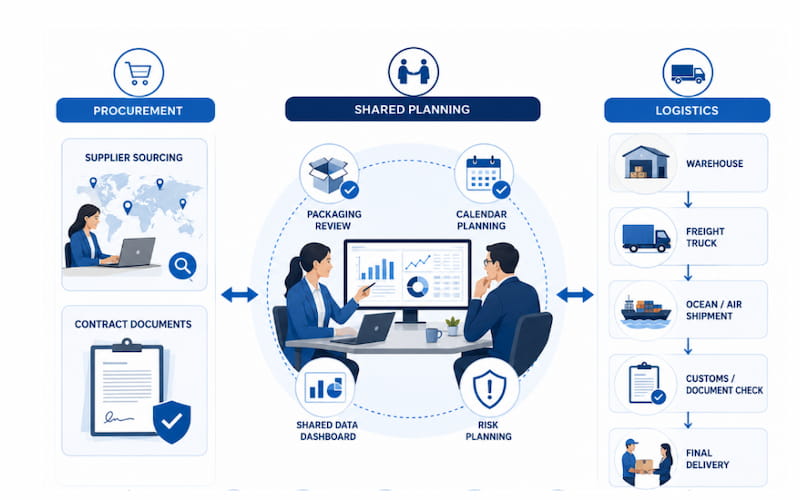
1. Align Sourcing With Realistic Logistics Windows
Procurement should consult logistics before committing to production and delivery dates.
Both teams should review:
- Factory lead time
- Inspection requirements
- Port cut-off dates
- Freight availability
- Customs preparation
- Warehouse capacity
- Final delivery deadlines
This prevents the business from agreeing to a production schedule that cannot support the required launch or campaign date.
2. Select Incoterms Before Finalising the Contract
Incoterms should not be treated as a minor detail added after supplier negotiation.
The selected term affects freight control, insurance, documentation, customs responsibilities, risk transfer, and exposure to additional costs. Procurement and logistics should agree on the appropriate term before the contract is signed.
3. Use Shared Supplier and Carrier Scorecards
Supplier and carrier performance should be assessed together.
A supplier may finish production on schedule but fail to prepare the correct documentation or meet the freight cut-off. A carrier may meet its transit commitment, but only after production has already delayed the order.
A combined scorecard can track:
- Production readiness
- Quality performance
- Documentation accuracy
- Freight booking compliance
- Shipment reliability
- Final OTIF delivery
This gives the business a more accurate view of end-to-end performance.
4. Plan Inbound and Outbound Logistics Together
Inbound logistics may cover transport from the factory to a warehouse or consolidation centre. Outbound logistics covers movement from that facility to distributors, retailers, campaign locations, or customers.
Planning both stages together can reduce unnecessary storage, repeated handling, and avoidable delays.
The teams should also confirm whether products require inspection, labelling, kitting, repacking, or market-specific allocation before export.
5. Coordinate Packaging With Freight Requirements
Product packaging affects more than presentation and protection. It can influence container utilisation, parcel dimensions, freight charges, damage risk, warehouse handling, and shipment emissions.
Procurement, packaging designers, suppliers, and logistics teams should review:
- Carton dimensions
- Product weight
- Pallet configuration
- Protection requirements
- Labelling
- Destination regulations
- Container or vehicle utilisation
This is particularly important for promotional products, retail displays, and POSM with unusual shapes or fragile components.
6. Create One View of Product and Logistics Spend
Supplier pricing and logistics costs are often managed in separate systems, which can hide the real cost of an order.
A connected spend view should include:
- Product cost
- Tooling and sampling
- Inspection
- Packaging
- Inland transport
- International freight
- Insurance
- Duties and customs charges
- Warehousing
- Fulfilment
- Last-mile delivery
This allows suppliers and routes to be evaluated using total landed cost rather than unit price alone.
7. Develop a Joint Risk Plan
Supplier and logistics risks frequently affect one another.
Severe weather may interrupt production and port operations in the same region. A material shortage may delay manufacturing until reserved freight space is no longer available. Incorrect documentation may create a customs delay even when production finishes on time.
A shared risk plan should define alternative suppliers, routes, carriers, inspection arrangements, escalation contacts, and stock buffers where appropriate.
8. Review Performance Together
Quarterly or project-based reviews should combine procurement and logistics metrics.
The objective is not to optimise one department independently. It is to improve product quality, total cost, lead time, delivery reliability, and customer outcomes across the complete order.
How Does an Asia-to-EU or US Order Move From Factory to Warehouse?
A typical branded merchandise order may pass through seven connected stages.
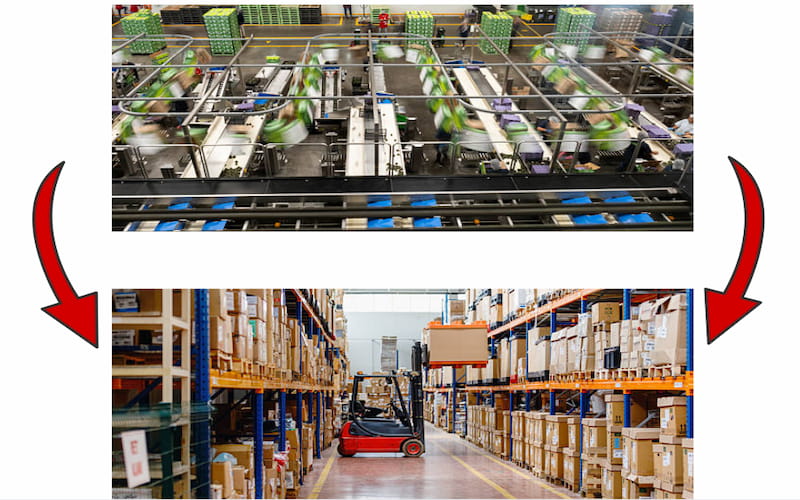
Stage 1: Supplier Evaluation and Quotation
Procurement identifies suitable factories and compares pricing, product capability, quality systems, capacity, lead times, and commercial terms.
Logistics contributes information about factory location, port access, freight options, export documentation, and potential route constraints.
Stage 2: Sampling, Production, and Quality Planning
Procurement coordinates specifications, prototypes, sample approval, and production terms.
Inspection stages, quality tolerances, packaging standards, and corrective action procedures should be agreed before manufacturing begins. Logistics uses the expected completion date to prepare freight and warehouse plans.
Stage 3: Final Inspection and Export Preparation
Finished products may undergo a pre-shipment inspection before being released.
The supplier must also prepare the agreed cartons, labels, packing lists, commercial invoices, certificates, and other required documentation. Errors at this point can delay freight booking or customs clearance.
Stage 4: Consolidation and Warehousing
Products may move directly to the port or enter a warehouse for consolidation, kitting, relabelling, stockholding, or final quality checks.
Consolidation is particularly useful when several factories are supplying products for the same campaign or destination.
Stage 5: International Freight
Logistics selects air, sea, road, rail, or multimodal transport according to the required delivery date, budget, product characteristics, and route availability.
Ocean freight generally suits larger orders with sufficient planning time. Air freight may be more appropriate for urgent, lightweight, or high-value products, although it normally carries a higher cost.
Stage 6: Customs and Destination Delivery
The responsible party prepares import documentation, product classification details, origin information, and other customs requirements.
After clearance, goods may move to a central warehouse, regional distributor, retailer, event location, or fulfilment centre.
Stage 7: Tracking, Reconciliation, and Review
Shipment tracking should be connected to the purchase order, supplier commitment, and required delivery date.
After delivery, procurement and logistics should review final cost, timing, quality, damages, customs issues, and supplier or carrier performance.
Which Technologies Connect Procurement and Logistics?
The most useful technology is not necessarily one large platform. It is a connected system that allows purchasing, production, inventory, and shipment data to move between teams.
A modern setup may include:
- eSourcing and supplier management
- Purchase order and contract management
- Production tracking
- Quality inspection reporting
- Transportation management
- Warehouse management
- Shipment visibility
- Customs documentation
- Freight auditing
- Spend and landed-cost reporting
For businesses improving their wider business procurement process, the priority should be creating reliable connections between supplier commitments and logistics execution rather than adding disconnected tools.
Product names, supplier references, purchase orders, cartons, and shipment records should use compatible identifiers. Without consistent data, even advanced software will struggle to provide reliable visibility.
What Problems Occur When Procurement and Logistics Remain Separate?
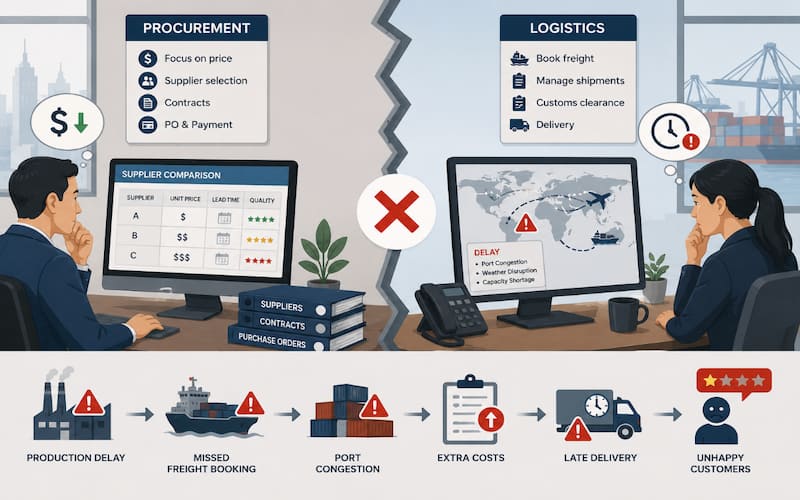
Low Unit Prices Can Create High Landed Costs
Procurement may select the lowest-priced supplier without considering inland transport, inefficient packaging, poor container utilisation, or distance from the export port.
The product costs less at the factory but more by the time it reaches its destination.
Freight May Be Booked Before Production Is Ready
Logistics may reserve capacity based on an unrealistic manufacturing date.
If production is delayed, the company may lose the booking, pay additional charges, or require a more expensive transport option to meet the deadline.
Product Designs May Be Difficult to Ship
A product or display may be approved without reviewing packaging dimensions, fragility, stacking, or warehouse handling.
This can increase freight costs, damage rates, and storage requirements.
Teams May Follow Conflicting KPIs
Procurement may be rewarded for reducing supplier prices, while logistics is measured on delivery speed.
Without shared targets, one team’s improvement may create additional cost or delay for the other.
A well-structured procurement team should therefore define clear ownership for production coordination, supplier communication, quality control, and logistics handovers.
Data May Not Match Across Systems
Supplier records, purchase orders, shipment references, inventory records, and invoices may use different product descriptions or codes.
This makes it harder to calculate landed cost, trace orders, and identify the cause of delays.
Which Procurement and Logistics Trends Matter in 2026?

AI Is Supporting Planning and Exception Management
AI is increasingly being used to organise spend data, review documents, monitor suppliers, identify shipment exceptions, predict arrival times, and support inventory or routing decisions.
Its practical value comes from identifying risks earlier and helping teams prioritise action. Human oversight remains necessary for negotiation, supplier relationships, compliance decisions, and unexpected disruptions.
Shipment Visibility Is Moving Closer to Real Time
Businesses increasingly expect visibility across production, inspection, freight, customs, warehousing, and delivery.
A shipment tracking link alone is not enough when it is disconnected from the purchase order, campaign deadline, and supplier commitment. Visibility becomes more useful when it explains whether an order remains on schedule and who must act when it does not.
Resilience Is Influencing Supplier Selection
Freight disruption and changing trade routes are encouraging businesses to assess supplier location alongside cost and quality.
UNCTAD identifies volatile freight rates, longer routes, and port disruption as continuing pressures on maritime trade. This makes qualified alternative suppliers, carriers, and transport plans more important.
Supplier Consolidation Requires Qualified Alternatives
Reducing unnecessary suppliers can simplify administration and improve purchasing leverage. However, relying on one supplier or region can create greater exposure to disruption.
Businesses should consolidate where it improves efficiency while maintaining credible alternatives for critical products, materials, and markets.
Near-Shoring and Multi-Region Sourcing Are Becoming More Selective
Businesses may use nearby suppliers for urgent, customised, or frequently replenished products while retaining Asian suppliers for scalable or cost-sensitive manufacturing.
The correct model depends on product complexity, volume, quality requirements, destination, and delivery frequency.
Carbon Data Is Becoming Part of Operational Planning
Product design, factory selection, materials, packaging, freight mode, and routes all affect the data needed to assess environmental impact.
This is particularly relevant for consumer goods procurement, where frequent orders, packaging requirements, and distribution volumes can create large amounts of supplier and shipment information.
Should APAC Logistics Be Managed In-House or Outsourced?
| Factor | In-House Management May Suit | An Integrated Partner May Suit |
| Internal team | Established sourcing, trade, customs, and freight specialists | Limited local sourcing or logistics resources |
| Shipment volume | Consistent and predictable | Seasonal, campaign-based, or changing |
| Supplier network | Mature and regularly reviewed | New, fragmented, or still developing |
| Technology | Connected procurement and logistics systems | Limited visibility across suppliers and shipments |
| Geographic presence | Local teams near suppliers and ports | Management from another region |
| Compliance | Strong customs and documentation capability | Support needed with export and import processes |
| Quality control | Internal inspection resources available | Local inspection coordination required |
| Best fit | Large businesses seeking direct control | Growing brands seeking one accountable workflow |
The decision does not need to be entirely in-house or outsourced. A company may retain sourcing strategy, supplier approval, and budget control internally while outsourcing inspections, factory coordination, warehousing, and freight execution.
When comparing procurement partners, businesses should confirm which responsibilities remain internal, which services are included, and how performance will be measured. Savings should not be assumed before a project begins because results depend on specifications, volumes, existing terms, quality requirements, and logistics complexity.
How Does UCT Asia Integrate Procurement and Logistics?
UCT Asia connects product development, sourcing, mass production, quality assurance, fulfilment, and logistics within one procurement process.
Its support can include:
- Product design and prototyping
- Supplier identification
- RFQ and commercial negotiation
- Material and product sourcing
- Production coordination
- Quality inspections and testing
- Warehousing
- Stockholding
- Pick-and-pack fulfilment
- Dispatch and shipment tracking
- Logistics documentation
- Custom promotional products
- On-pack marketing
- POSM
UCT Asia’s third procurement phase includes quality assurance, warehousing, pick-and-pack services, dispatching, stock alerts, tracking, documentation, and logistics support.
This connected structure reduces the number of handovers between sourcing companies, inspection providers, warehouses, freight forwarders, and fulfilment partners.
Conclusion
Procurement determines what a business buys, which supplier produces it, and under which terms. Logistics ensures that the finished product is prepared, transported, stored, and delivered according to the required schedule.
The strongest workflows connect both functions before the supplier is selected. Procurement and logistics teams should share production dates, packaging requirements, Incoterms, landed-cost data, risk plans, and delivery KPIs throughout the order.
At UCT (Asia), we specialise in POS merchandise, displays, serving materials, loyalty gifts, promotional products, retail items, printed materials, on-packs, and corporate gifts. We support leading promotional companies, marketing procurement teams, and fulfilment agencies from product creation and prototyping through manufacturing and delivery, with integrated design, R&D, sourcing, engineering, and production capabilities across Asia and the United States.
Frequently Asked Questions
What Is the Main Difference Between Procurement and Logistics?
Procurement manages sourcing, suppliers, purchasing, contracts, and commercial value. Logistics manages transportation, warehousing, fulfilment, customs coordination, and delivery.
The functions overlap around production schedules, packaging, Incoterms, shipment preparation, and total landed cost.
Why Are Procurement and Logistics Becoming More Connected?
International sourcing requires supplier and logistics decisions to be made together.
Factory location, production timing, packaging, freight capacity, customs requirements, and delivery deadlines affect one another. Separate planning can create unnecessary costs and delays.
What Is the Best Incoterm for Asia-Sourced Shipments?
There is no single best Incoterm for every shipment.
The right choice depends on the transport mode, destination, buyer experience, customs arrangements, tax position, required control, and commercial agreement. The selected rule and named location should be included in the contract.
How Should Procurement and Logistics Integration Be Measured?
Useful shared KPIs include:
- Total landed cost
- End-to-end lead time
- On-time-in-full delivery
- Supplier production reliability
- Documentation accuracy
- Quality and damage rates
- Freight cost per unit
- Inventory accuracy
- Shipment emissions data where required
What Technology Is Needed?
Businesses need systems that connect supplier, purchase order, production, inventory, shipment, and cost information.
The exact platform matters less than reliable data, clear ownership, compatible product identifiers, and timely updates.
Should Logistics Be Managed In-House or Outsourced?
In-house management may suit businesses with established regional teams, consistent shipment volumes, connected technology, and strong freight expertise.
Outsourcing may suit businesses that need local supplier coordination, inspections, warehousing, freight management, or flexible resources without building a complete APAC operation.
What Role Does Sustainability Play?
Sustainability can affect supplier selection, manufacturing methods, materials, packaging, freight modes, route planning, and reporting.
Procurement and logistics must share information because supplier data alone does not show the impact of transportation, warehousing, and distribution.