
For growing businesses, procurement has a direct effect on cost control, product quality, supplier reliability and customer experience. Yet it is still often treated as a back-office purchasing task.
In reality, procurement is the discipline of making informed buying decisions. It helps businesses source the right products and services, reduce supplier risk, manage quality expectations and protect margins without compromising the end result.
This guide is for operations managers, founders and finance leaders who need a practical definition of procurement, a process they can implement, and a realistic view of the tools and controls that support better purchasing decisions. It is not an enterprise procurement theory. It is a practical guide for businesses managing real supplier relationships, product timelines and commercial priorities.
What Is Procurement?
Procurement Is the Strategic Process of Managing What a Business Buys

Procurement is the strategic process of identifying business needs, sourcing suppliers, negotiating terms, purchasing goods or services, and managing supplier relationships to achieve the best overall value for an organization.
It is broader than purchasing because it includes market research, supplier vetting, contract management, quality planning and ongoing supplier performance reviews.
In simple terms, procurement covers everything before and after a purchase order. Purchasing is the act of placing an order. Procurement determines whether the order is necessary, which supplier should receive it, what terms should apply and how that supplier performs over time.
For custom promotional products, branded merchandise and retail items, procurement may also involve product development before production begins. UCT Asia’s guide to understanding the procurement process explains how design, sourcing, production and quality control work together in a complete procurement workflow.
Why Does Procurement Matter?
Procurement Helps Businesses Protect Margins, Quality and Supply Reliability
Procurement has become a management priority rather than a purely administrative function for three main reasons.
- Supply chain volatility. Shipping disruption, supplier capacity changes and geopolitical uncertainty have shown businesses that depending on a single supplier can create unnecessary risk.
- Margin pressure. Rising material costs, freight costs and labor expenses make purchasing decisions more important. Better supplier terms, consolidated buying and reduced waste can protect margins without lowering quality.
- Higher customer expectations. Buyers expect products to arrive on time, match specifications and reflect the quality promised by the brand. Procurement plays a direct role in meeting those expectations.
Without a defined procurement process, businesses can lose visibility over pricing, supplier performance and order quality. That usually leads to avoidable costs, missed deadlines and inconsistent results.
What Are the Main Types of Procurement?
The Main Types Are Direct, Indirect, Services, Construction and Government Procurement
| Type | What It Covers | Example | Typical Spend Area |
| Direct procurement | Goods and services used to create a product | Raw materials, components, packaging, branded merchandise | Cost of goods sold |
| Indirect procurement | Goods and services needed to run the business | Office supplies, software, marketing, facility maintenance | Operating expenses |
| Services procurement | External labor and specialist expertise | Consultants, contractors, agencies, legal counsel | Professional services |
| Construction procurement | Materials and labor for capital projects | Retail fit-outs, warehouse upgrades, equipment installation | Project-based spending |
| Government procurement | Public-sector contracting requirements | Tender submissions, compliance documentation | Public contracts |
Most businesses focus heavily on direct and indirect procurement.
Direct procurement matters most when products, packaging or materials directly affect what the customer receives. Indirect procurement covers the purchases that support daily operations but do not become part of the final product.
Understanding the difference between direct and indirect procurement helps businesses apply the right buying strategy, approval process and supplier management approach to each category.
How Does the Procurement Process Work?
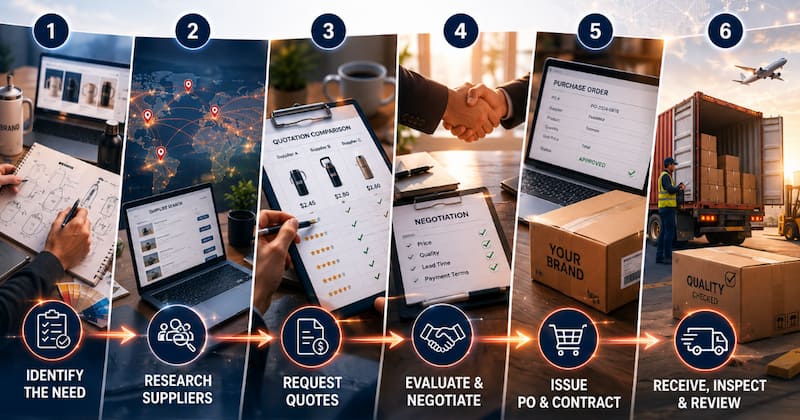
A Six-Step Procurement Process Gives Businesses a Practical Starting Point
A simple procurement process can create much better control without adding unnecessary complexity.
Step 1: Identify the Need Clearly
Document what you are buying, why it is needed and what outcome is expected. A one-page requirement brief is often enough.
Include:
- Quantity and expected order volume
- Product specifications or service requirements
- Quality standards
- Delivery timing
- Budget range
- Packaging, branding or compliance requirements where relevant
For custom merchandise, this may involve concept development, material selection and prototyping before supplier quotes are requested. UCT Asia’s design, engineering and prototyping services show why these requirements should be clarified early.
Step 2: Research the Supplier Market
Identify three to five potential suppliers. Use sourcing platforms, trade directories, existing supplier networks, referrals and industry contacts.
When sourcing internationally, look beyond the unit price. Production capacity, lead times, sample quality, communication, certifications, packaging standards and shipping capabilities all affect the total cost and reliability of the project.
Businesses sourcing products from overseas may find UCT Asia’s guide on how to source products from Asia useful when evaluating supplier options.
Step 3: Request Quotes or Proposals
Use a Request for Quote, or RFQ, when price is the main decision factor. Use a Request for Proposal, or RFP, when the purchase involves more complex services, product development or long-term support.
Set evaluation criteria before reviewing responses. This helps prevent suppliers from being selected purely because they offer the lowest initial price.
Step 4: Evaluate Suppliers and Negotiate Terms
Assess suppliers based on price, quality, capacity, reliability, communication, lead time and risk.
Negotiate payment terms, production schedules, minimum order quantities, delivery dates and quality expectations. For product-based procurement, it is also important to confirm samples, artwork approvals, packaging details and inspection requirements before mass production begins.
Step 5: Issue the Purchase Order and Contract
Use a written purchase order for goods and a clear agreement for services.
For significant purchases, the documentation should cover:
- Product or service specifications
- Pricing and payment terms
- Delivery timelines
- Quality requirements
- Responsibilities of each party
- Cancellation or exit terms
Clear documentation protects both the buyer and supplier when expectations change or issues arise.
Step 6: Receive, Inspect and Review Performance
Inspect goods on arrival and track supplier performance over time. Useful measures include on-time delivery, defect rates, responsiveness, order accuracy and consistency with approved samples.
For promotional merchandise and branded products, quality assurance should start before shipment, not after products arrive. UCT Asia’s quality assurance, fulfillment and logistics services cover inspection, fulfilment and delivery coordination across the final stages of procurement.
What Is the Difference Between Direct and Indirect Procurement?
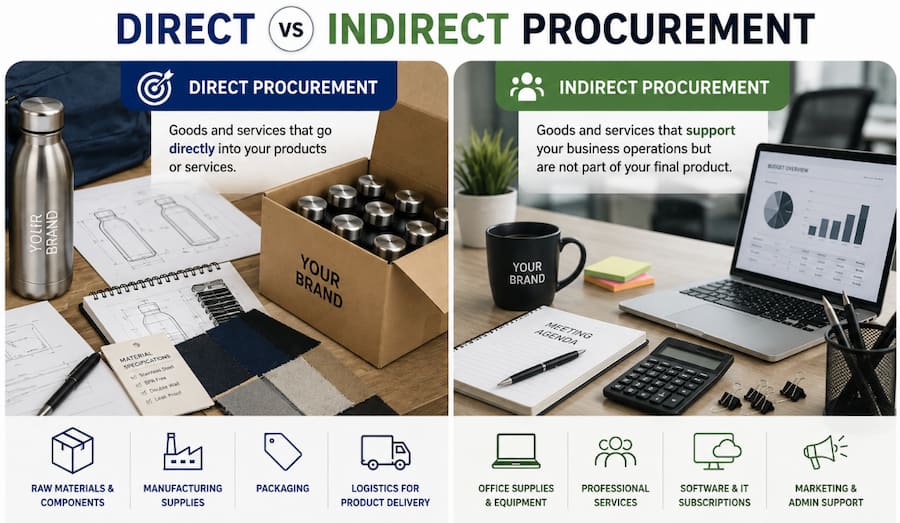
Direct Procurement Supports Product Delivery, While Indirect Procurement Supports Operations
| Dimension | Direct Procurement | Indirect Procurement |
| Spend impact | Direct input to products or customer-facing materials | Operating expense |
| Buyer profile | Product, supply chain and operations teams | Office managers and department heads |
| Supplier relationship | Strategic and often long-term | More transactional or fragmented |
| Negotiation leverage | Usually stronger due to order volume | Often lower for one-off purchases |
| Priority for control | High | Important, but often secondary |
For a company sourcing branded retail products, promotional gifts or event materials, direct procurement includes the items customers, employees or partners receive.
Indirect procurement may include software subscriptions, office equipment, marketing services, employee training or professional support.
Both categories require oversight, but direct procurement usually has a more immediate impact on brand perception, product quality and customer satisfaction.
What Is the Difference Between Procurement and Purchasing?
Procurement Is Strategic, While Purchasing Is Transactional
The terms are often used interchangeably, but they are not the same.
Purchasing is the transactional act of raising purchase orders, receiving goods and paying invoices.
Procurement is the broader strategic function of identifying needs, selecting suppliers, negotiating contracts, managing quality expectations and reviewing supplier performance.
Think of purchasing as one action within a much larger system. Businesses that only focus on purchasing can lose visibility over supplier risk, pricing consistency and quality control.
Which Digital Procurement Tools Suit Growing Businesses?
Procurement Software Can Improve Approval Workflows and Spend Visibility
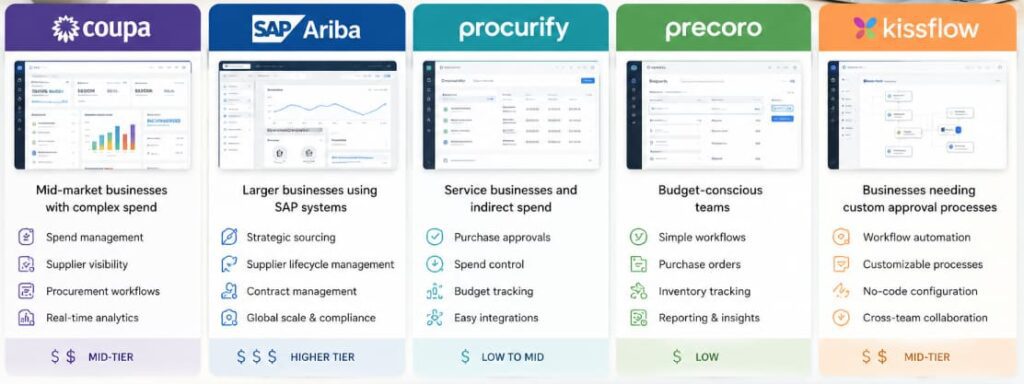
Procurement software does not always require a large implementation team or enterprise-level budget. The right platform depends on supplier volume, purchasing complexity, workflow requirements and existing systems.
| Tool | Best For | Pricing Tier | Main Strength |
| Coupa | Mid-market businesses with complex spend | Mid-tier | Spend management and supplier visibility |
| SAP Ariba | Larger businesses using SAP systems | Higher | Enterprise sourcing and procurement workflows |
| Procurify | Service businesses and indirect spend | Low to mid | Purchase approvals and spend control |
| Precoro | Budget-conscious teams | Low | Simple purchasing workflows |
| Kissflow | Businesses needing custom approval processes | Mid | Flexible workflow automation |
For a business still managing procurement through spreadsheets and email chains, a simple approval and purchase-order platform can be a useful first step. Before selecting software, assess supplier volume, approval workflows, reporting needs, integration requirements and the level of control your team actually needs.
What Procurement Trends Are Affecting Businesses?
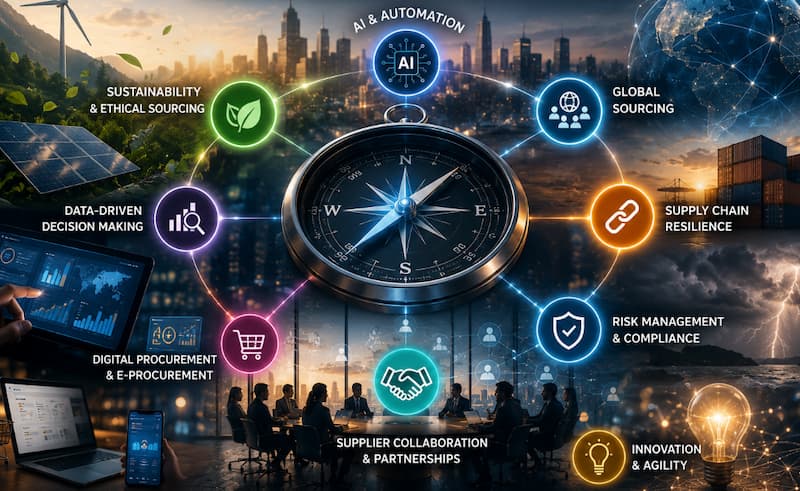
Supplier Diversification, Compliance and AI Are Reshaping Procurement
Three developments are reshaping procurement decisions.
Supplier diversification. Many businesses are reducing reliance on one country, one factory or one supplier. Developing qualified alternatives can strengthen resilience and improve negotiation leverage.
Compliance and sustainability expectations. Buyers increasingly want visibility over materials, product safety, labor standards and environmental considerations. These requirements are particularly important for consumer-facing products, branded merchandise and retail programs.
AI-assisted sourcing. Procurement platforms increasingly use AI to organize supplier data, identify pricing patterns, flag delivery risks and streamline routine purchasing workflows. For most businesses, the immediate value is improved visibility rather than full automation.
How Can You Build a Procurement Function?
A Procurement Function Can Start With One Owner and a Clear Policy
A procurement function does not need to begin as a full department. It can start with one responsible owner, often an operations manager, supported by a written policy and a clear approval structure.
The common mistake is treating procurement as administration rather than a strategic discipline. This can lead to inconsistent supplier selection, unmanaged spending, weak contracts and missing documentation when issues arise.
For growing businesses, the priority is to create repeatable buying controls before spending becomes difficult to manage.
What Should a Simple Procurement Policy Include?
A One-Page Procurement Policy Can Formalize Core Buying Controls
- A procurement policy does not need to be 40 pages long. A one-page document can provide a clear foundation by covering the following points.
- Approval thresholds: Define who can approve purchases at each spending level. For example, department leads may approve lower-value purchases, while senior management approves larger or higher-risk commitments.
- Sole-source justification: Require a written explanation when selecting one supplier without competitive quotes. This reduces dependency and improves transparency.
- Contract requirements: Define when written contracts are mandatory. Service engagements, custom product orders and higher-value purchases should include clear deliverables, payment terms and exit conditions.
- Supplier evaluation: Require documented assessments for significant new suppliers. A simple scorecard covering price, quality, delivery, responsiveness and risk is usually enough.
Which Roles Support a Growing Procurement Function?
Procurement Teams Usually Combine Strategic, Operational and Specialist Roles
| Role | Responsibility | Typical In-House or Outsourced Model |
| Procurement Manager | Strategy, supplier relationships and contract negotiation | In-house as spend grows |
| Buyer or Purchasing Officer | Day-to-day purchase orders and invoice matching | In-house or shared service |
| Category Specialist | Expertise in a specific spend category | Often outsourced |
| Supplier Quality Specialist | Supplier audits, inspections and quality reviews | Often outsourced |
| Contract Administrator | Contract tracking, renewals and compliance | In-house or outsourced |
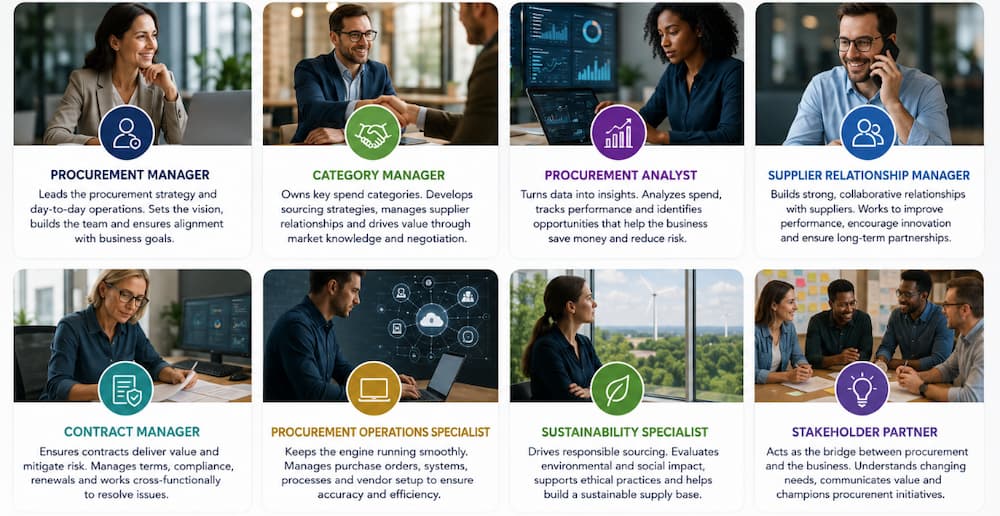
For many businesses, the first two roles are the most important starting point. Specialist support can be added when supplier volume, product complexity or order risk increases.
Businesses managing branded merchandise programs can also use an external procurement partner to coordinate product design, sourcing, manufacturing, quality assurance and delivery in one workflow.
What Procurement Mistakes Should Businesses Avoid?
Avoiding Weak Supplier Controls and Unmanaged Spend Protects Business Value
Several procurement mistakes appear repeatedly across growing organizations.
- Treating price as the only criterion: The lowest quote can become the most expensive choice when defects, late deliveries, freight issues and supplier churn are included.
- Skipping contract documentation: Informal agreements and email threads leave businesses exposed when suppliers miss deadlines or deliver products that do not meet the agreed specification.
- Not tracking supplier performance: If you cannot identify which suppliers delivered on time or met quality expectations last quarter, you cannot make better decisions in the next buying cycle.
- Using the same supplier for years without benchmarking: Supplier pricing, capacity and quality can change. Periodic RFQs help businesses maintain market awareness and improve negotiating power.
- Allowing maverick spendA: Maverick spend occurs when employees buy outside the approved process. It reduces visibility, weakens buying leverage and increases risk.
What Procurement Checklist Can You Use This Quarter?
This 30-Day Checklist Helps Businesses Build Procurement Discipline
- Map suppliers by category: direct, indirect and services
- Calculate total spend per supplier for the last 12 months
- Identify the top 10 suppliers by spend
- Confirm contracts and review performance for strategic suppliers
- Implement a written purchase-order process
- Create a supplier scorecard for price, quality, delivery and responsiveness
- Run one competitive RFQ for a high-spend category
- Review progress after 90 days and adjust the process
Conclusion
Better Procurement Builds More Reliable and Profitable Businesses
Procurement is not simply about choosing the lowest price. It is about making structured purchasing decisions that protect quality, reduce risk, improve supplier accountability and support stronger margins. A clear process, documented approvals and regular supplier reviews create a practical foundation for more dependable growth.
At UCT Asia, we help brands manage gift merchandise procurement from product development and supplier sourcing through to manufacturing, quality inspection, fulfillment and logistics. Our sourcing and procurement services support businesses that need reliable, well-managed branded merchandise programs across international supply chains. To learn more about our end-to-end approach, contact UCT Asia to discuss your project.
FAQ: Procurement Questions From Operations Managers
What Is Procurement in Simple Words?
Procurement is the process of finding suppliers, negotiating with them, buying goods or services, and managing the relationship over time. It is broader than simply placing an order.
What Is the Difference Between Procurement and Purchasing?
Purchasing is the transactional act of buying. Procurement is the wider strategic process that determines what to buy, from whom, on what terms and how the supplier relationship should be managed.
What Are the Four Main Types of Procurement?
The four most common types are direct procurement, indirect procurement, services procurement and construction procurement.
What Are the Five Steps of Procurement?
A practical five-step framework is to identify the need, research suppliers, request quotes, evaluate and negotiate, then issue the purchase order. Many businesses add a sixth step: reviewing supplier performance afterward.
Why Is Procurement Important for Small Businesses?
Procurement helps small businesses control costs, improve supplier reliability, protect quality and reduce unnecessary spending. Even small improvements in buying discipline can improve cash flow, customer satisfaction and margins.
How Does Procurement Differ for Service Businesses and Manufacturers?
Manufacturers usually focus more on direct procurement, including raw materials and components. Service businesses often focus more on services and indirect procurement, such as contractors, software subscriptions and professional support.
What Is Maverick Spend and Why Does It Matter?
Maverick spend is purchasing that happens outside the approved procurement process, often when employees buy directly using company cards. It reduces visibility, weakens pricing leverage and can increase supplier risk.
How Do I Start a Procurement Function in a 50-Person Company?
Start with a procurement policy, a written purchase-order process and one person responsible for strategic suppliers, usually an operations manager. Add software when supplier volume, approvals and spending become difficult to manage manually.
What Is the Difference Between Strategic and Operational Procurement?
Strategic procurement focuses on long-term supplier relationships, category management and total cost of ownership. Operational procurement manages day-to-day purchase orders and transactions. Both are important, but strategic procurement creates the foundation for long-term value.
Is Procurement the Same as Supply Chain Management?
No. Procurement is one part of supply chain management. Supply chain management covers the full movement of goods from raw materials to the end customer, while procurement focuses on what the business buys and the suppliers it works with. For a deeper comparison, read the difference between procurement and supply chain management.