
The terms procurement agent and procurement manager are sometimes used interchangeably, but they usually describe roles with different levels of responsibility, authority, salary, and career progression.
A procurement agent focuses mainly on the operational work that keeps purchasing moving, including quotations, purchase orders, supplier follow-ups, and delivery issues. A procurement manager has broader responsibility for sourcing strategy, contracts, supplier performance, risk, budgets, and team leadership.
The distinction is becoming more important as AI automates repetitive procurement tasks while businesses expect procurement leaders to contribute more to cost control, resilience, and strategic planning.
How Do Procurement Agents and Procurement Managers Compare?
| Area | Procurement Agent | Procurement Manager |
| Primary focus | Operational purchasing | Strategy and leadership |
| Typical work | Quotations, POs, records, and supplier follow-ups | Contracts, sourcing strategy, supplier reviews, and team management |
| Decision-making | Works within established policies and approval limits | Makes broader supplier and category decisions |
| Supplier contact | Day-to-day operational communication | Strategic and commercial relationship management |
| Core KPIs | Accuracy, cycle time, responsiveness, and delivery | Savings, total cost, supplier performance, risk, and team results |
| Career stage | Entry-level to experienced individual contributor | Experienced professional or team leader |
| AI impact | Higher exposure to task automation | Greater use of AI for analysis and decision support |
Responsibilities still vary by company. In a smaller business, one employee may perform both roles. Larger organisations usually separate operational purchasing from strategic procurement management.
What Does a Procurement Agent Do?

A procurement agent manages the day-to-day activities required to purchase goods or services from approved suppliers.
Typical responsibilities include:
- Requesting and comparing quotations
- Preparing purchase orders
- Following up on production and delivery dates
- Maintaining supplier and product records
- Checking invoices against purchase orders
- Resolving routine quantity, quality, or delivery issues
- Coordinating with finance, operations, and warehouses
The U.S. Bureau of Labor Statistics describes buyers and purchasing agents as professionals who evaluate suppliers, negotiate contracts, review product quality, and monitor inventories and deliveries.
The role requires strong attention to detail because errors in quantities, specifications, currencies, product codes, or delivery details can create delays and additional costs. Procurement agents also need clear supplier communication, commercial awareness, and confidence using ERP or procure-to-pay systems.
Their performance is usually measured through operational KPIs such as purchase order accuracy, cycle time, response time, overdue orders, invoice discrepancies, and supplier delivery performance.
What Does a Procurement Manager Do?

A procurement manager is responsible for the broader commercial and strategic performance of procurement.
Rather than focusing mainly on individual transactions, the manager decides how suppliers, contracts, sourcing activities, and procurement resources should be managed. The role may include developing category strategies, leading tenders, negotiating important agreements, approving suppliers, and improving procurement processes.
Procurement managers commonly:
- Develop sourcing and category strategies
- Lead RFQ, RFP, and tender processes
- Negotiate significant supplier contracts
- Manage strategic supplier relationships
- Monitor cost, quality, delivery, compliance, and risk
- Lead buyers, agents, coordinators, or analysts
- Report procurement performance to management
A manager must look beyond the quoted unit price. Supplier capacity, total landed cost, quality, working capital, contract exposure, and business continuity may all influence the final decision.
The role also carries leadership responsibility. Managers allocate work, review team performance, manage escalations, and represent procurement in discussions with finance, operations, marketing, engineering, and senior leadership.
What Are the Main Differences Between the Roles?
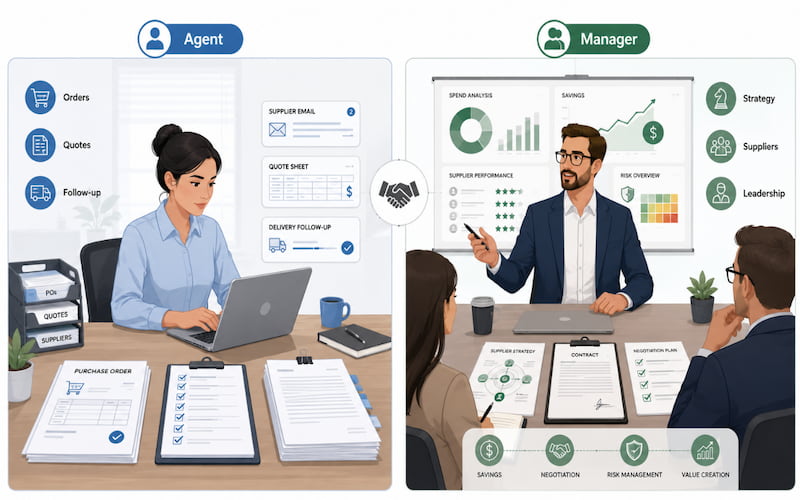
1. Agents Execute the Process While Managers Shape It
A procurement agent works within an established purchasing process. The agent gathers quotations, prepares documentation, issues approved orders, and follows up with suppliers.
A procurement manager decides how the process should operate, which suppliers qualify, how proposals are assessed, and what commercial standards should apply.
Experienced agents may still negotiate routine purchases or support sourcing projects. The main difference is the level of ownership and accountability.
2. Managers Have Broader Decision-Making Authority
Agents usually make decisions within predefined limits. High-value purchases, new suppliers, unusual contract terms, or compliance concerns are normally escalated.
Managers have greater authority to approve or recommend supplier awards, contract terms, sourcing changes, and corrective actions.
There is no universal approval threshold for either role. Authority depends on company size, internal policy, purchase value, category risk, and seniority.
3. The Roles Use Different KPIs
Agents are generally measured on operational performance, including speed, accuracy, responsiveness, and order completion.
Managers are more likely to be assessed on commercial outcomes such as savings, total landed cost, supplier performance, contract compliance, risk, and team output.
An agent may be responsible for issuing a purchase order correctly. The manager is responsible for deciding whether the supplier, contract, and sourcing approach deliver sufficient business value.
4. Supplier Relationships Operate at Different Levels
Agents communicate with suppliers about quotations, samples, documents, production status, invoices, and delivery dates.
Managers handle the strategic relationship, including pricing reviews, capacity commitments, service levels, quality trends, innovation, supplier development, and continuity planning.
Both levels are necessary. Strategic supplier plans cannot succeed when daily production and delivery issues are not managed effectively.
5. Managers Carry Leadership Responsibility
Most procurement agents are individual contributors, although senior agents may train colleagues or coordinate projects.
Managers are responsible for ensuring that the wider team works effectively. This includes clarifying ownership, reviewing workloads, managing performance, improving processes, and supporting professional development.
6. Managers Focus More on Risk and Strategy
A procurement agent may identify a delayed order or missing supplier document. A manager decides whether that issue requires an alternative supplier, contract change, stock buffer, or wider sourcing review.
This broader perspective is particularly important when procurement decisions affect production, customer deadlines, margins, or business continuity.
7. AI Affects the Roles Differently
AI can now support spend classification, supplier research, quotation comparison, purchase order preparation, contract review, and the identification of unusual transactions.
This directly affects many repetitive agent tasks. However, agents are still needed to verify data, manage exceptions, communicate with suppliers, and resolve operational issues.
Managers use AI more as a decision-support tool. It can help identify spending patterns, compare suppliers, prepare negotiation scenarios, and detect risks, but managers remain accountable for the final commercial decision.
How Do Salaries Compare?
Procurement managers normally earn more because they carry broader strategic, commercial, and leadership responsibilities.
According to the U.S. Bureau of Labor Statistics, the median annual wages in May 2024 were:
| Role | U.S. Median Annual Wage |
| Buyers and purchasing agents | $75,650 |
| Purchasing managers | $139,510 |
These figures are national occupational medians, not guaranteed 2026 salaries or recommended hiring ranges.
Salaries in Bangkok, Singapore, Hong Kong, Manila, Europe, and other markets should be checked against current local hiring data. Job titles are not always directly comparable. A Procurement Manager in one company may perform work similar to a Senior Buyer or Category Manager elsewhere.
What Is the Typical Procurement Career Path?
A procurement career normally progresses from operational purchasing into supplier ownership, category management, and leadership.
A typical path is:
Purchasing Assistant or Coordinator → Procurement Agent or Buyer → Senior Buyer or Sourcing Specialist → Procurement Manager or Category Manager → Procurement Director → Head of Procurement or CPO
Promotion is not based on years of experience alone. Employers also look for evidence of successful negotiation, supplier improvement, category ownership, financial understanding, stakeholder management, and leadership.
How Is AI Changing Procurement Careers in 2026?

AI is reducing the amount of time spent on routine procurement administration. Current platforms can help prepare sourcing events, classify spending, compare quotations, extract contract information, monitor supplier risks, and highlight exceptions.
The agent role is therefore moving toward work that requires more judgement, including supplier communication, discrepancy resolution, data analysis, and sourcing support.
For managers, AI can improve the speed and quality of analysis, but it does not replace negotiation, leadership, stakeholder management, or accountability.
A modern procurement team needs a combination of operational knowledge, digital capability, supplier expertise, and strategic judgement.
Which Qualifications Support Career Progression?
Professional qualifications can help agents build broader procurement knowledge and help managers develop stronger strategic and leadership skills.
The main pathways include:
- CIPS Level 4 Diploma: Often suitable for buyers, agents, and procurement specialists developing wider technical knowledge.
- CIPS Levels 5 and 6: More relevant to experienced professionals moving into strategic or leadership roles.
- CPSM: The Institute for Supply Management qualification covering supply management, integration, leadership, and transformation.
- Public procurement qualifications: Credentials such as CPPB and CPPO may be relevant to government and public-sector roles.
Qualifications can strengthen professional credibility, but they do not replace practical experience in supplier management, negotiation, commercial analysis, and problem-solving.
Which Role Does Your Business Need?
| Business Need | Procurement Agent | Procurement Manager |
| Process purchase requests and orders | Best fit | Can oversee |
| Follow up with suppliers | Best fit | Handles escalations |
| Maintain purchasing records | Best fit | Oversees reporting |
| Build sourcing strategy | Supports | Best fit |
| Negotiate major contracts | Limited support | Best fit |
| Consolidate or develop suppliers | Supports | Best fit |
| Lead a procurement team | No | Best fit |
| Manage procurement risk | Escalates issues | Best fit |
| Improve procurement governance | Supports | Best fit |
A procurement agent may be the right first hire when the main problems involve purchasing administration, supplier follow-ups, missing records, or overdue orders.
A procurement manager is more suitable when the business needs supplier strategy, major contract negotiation, stronger governance, supplier consolidation, or leadership across several categories.
Some companies need both. This is often the case when a manager spends so much time processing transactions that strategic sourcing and supplier development receive insufficient attention.
Businesses formalising their business procurement process should identify whether the main gap is operational execution or strategic control before creating the role.
How Can External Procurement Support Fit Into the Structure?

External procurement support may be useful when a business needs regional supplier knowledge, product development, engineering, prototyping, quality control, production coordination, or temporary project capacity.
An internal procurement manager can retain control of strategy, budgets, supplier approvals, and stakeholder communication while the external provider manages specific operational activities.
This model can be particularly useful for promotional companies, marketing procurement teams, and fulfilment agencies sourcing products from unfamiliar markets.
When comparing procurement partners, businesses should clarify who is responsible for supplier approval, negotiations, specifications, quality, production, delivery, and reporting before the project begins.
How Does UCT Asia Support Procurement Teams?
UCT (Asia) supports internal procurement managers and operational teams through product development, sourcing, prototyping, engineering, production coordination, quality control, and delivery.
This allows the client’s internal team to retain strategic control while using external product, manufacturing, and sourcing capabilities where required.
The model is particularly relevant when businesses need product expertise and supplier execution without immediately building a complete internal sourcing department.
Conclusion
Procurement agents and procurement managers support the same function, but they operate at different levels. Agents focus mainly on accurate and timely execution, while managers take responsibility for strategy, commercial decisions, supplier performance, risk, and leadership.
A business dealing with purchase order backlogs and supplier follow-ups may need an agent. A company facing fragmented suppliers, weak contracts, or complex sourcing decisions may need a manager. Growing organisations often benefit from combining both roles with clearly defined responsibilities.
At UCT (Asia), we specialise in POS merchandise, displays, serving materials, loyalty gifts, promotional products, retail items, printed materials, on-packs, and corporate gifts. We support leading promotional companies, marketing procurement teams, and fulfilment agencies from product creation and prototyping through manufacturing and delivery, with integrated design, R&D, sourcing, engineering, and production capabilities across Asia and the United States.
Frequently Asked Questions
What Does a Procurement Agent Do?
A procurement agent handles operational purchasing work such as requesting quotations, preparing purchase orders, following up with suppliers, maintaining records, and resolving routine order or delivery issues.
What Does a Procurement Manager Do?
A procurement manager develops sourcing strategies, negotiates contracts, manages important suppliers, monitors procurement performance, leads employees, and coordinates procurement with other departments.
Is a Procurement Agent the Same as a Buyer?
The titles often overlap. Both roles may evaluate suppliers, request quotations, place orders, and monitor deliveries.
The term “buyer” is common in retail, wholesale, and manufacturing, while “procurement agent” may be used more broadly for someone acquiring goods or services for an organisation.
Which Role Has the Higher Salary?
Procurement managers normally earn more because they have broader commercial, strategic, and leadership responsibilities.
According to the U.S. Bureau of Labor Statistics, the May 2024 median annual wage was $75,650 for buyers and purchasing agents and $139,510 for purchasing managers.
Can a Procurement Agent Become a Procurement Manager?
Yes. Moving from agent, buyer, or specialist into management is a common career path.
Progression normally requires experience in negotiation, supplier management, category ownership, commercial analysis, stakeholder communication, and leadership.
Will AI Replace Procurement Agents?
AI is likely to automate more repetitive tasks, but agents will still be needed to verify information, manage exceptions, communicate with suppliers, and resolve operational problems.
The role is more likely to become more analytical and digitally enabled than disappear entirely.
Should a Small Business Hire an Agent or Manager First?
An agent may be the better choice when purchasing administration and supplier follow-up are the main problems.
A manager may be more appropriate when the business needs supplier strategy, contract negotiation, risk management, or leadership across several purchasing categories.