
Building an effective procurement team in 2026 requires more than hiring buyers and assigning purchasing categories. Modern teams must balance sourcing, supplier relationships, cost control, quality, risk, compliance, technology, and stakeholder expectations.
AI is changing how procurement work is divided. Routine activities can increasingly be supported by automation, while procurement professionals focus more on negotiation, supplier performance, analysis, and exception management.
For companies sourcing from Southeast Asia, the structure must also account for local supplier communication, product development, quality control, production follow-ups, export requirements, and logistics. The right team combines central commercial control with regional execution capabilities.
What Defines an Effective Procurement Team?
An effective procurement team connects purchasing decisions with wider business goals. It does not focus only on finding the lowest supplier price.
The team should be able to:
- Understand business and product requirements
- Identify and evaluate suitable suppliers
- Negotiate contracts and commercial terms
- Manage quality, delivery, compliance, and risk
- Coordinate with finance, operations, marketing, and logistics
- Measure supplier and procurement performance
- Improve processes without losing human oversight
The ideal structure depends on the company’s spending, categories, geographic reach, supplier network, and product complexity. A small business may need one experienced procurement generalist, while a multinational company may require category managers, sourcing specialists, analysts, quality engineers, and regional support.
What Does a Procurement Team Do?

A procurement team manages how a business identifies requirements, evaluates suppliers, purchases goods or services, and monitors ongoing performance.
Its responsibilities normally fall into five connected areas.
Strategic Sourcing
Strategic sourcing involves analysing requirements, supplier markets, costs, risks, and alternatives before awarding work.
The team may manage supplier research, RFQs, RFPs, tenders, sample reviews, negotiations, and contract recommendations.
Supplier Management
Supplier management continues after the purchase order or contract is issued. Procurement monitors quality, capacity, delivery, pricing, documentation, compliance, and responsiveness.
Important suppliers may also require performance reviews, corrective action plans, development programmes, and continuity planning.
Cost and Commercial Management
An effective procurement team evaluates total value rather than unit price alone.
Product costs may need to be assessed alongside tooling, packaging, quality inspections, freight, duties, warehousing, payment terms, inventory requirements, and the cost of potential defects or delays.
Risk, Quality, and Compliance
Procurement may be responsible for supplier due diligence, quality standards, contractual risk, regulatory documents, ethical sourcing requirements, and business continuity.
These requirements should be considered during supplier evaluation rather than added immediately before production or shipment.
Procurement Operations and Data
Operational procurement includes purchase requests, purchase orders, supplier onboarding, invoice matching, approvals, record management, and delivery follow-ups.
Reliable supplier, product, contract, order, and delivery data helps the team identify risks and make better decisions. Technology can support this work, but it cannot correct unclear responsibilities or inaccurate data by itself.
Which Roles Does a Procurement Team Need?
Not every company needs a separate employee for every procurement activity. Smaller teams may combine several responsibilities, while larger organisations can create more specialised roles.
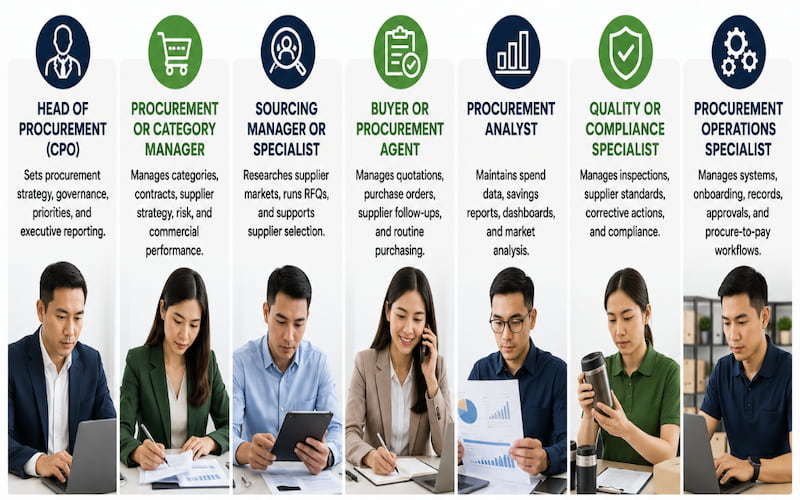
| Role | Main Responsibility |
| Head of Procurement or CPO | Sets procurement strategy, governance, priorities, and executive reporting |
| Procurement or Category Manager | Manages categories, contracts, supplier strategy, risk, and commercial performance |
| Sourcing Manager or Specialist | Researches supplier markets, runs RFQs, and supports supplier selection |
| Buyer or Procurement Agent | Manages quotations, purchase orders, supplier follow-ups, and routine purchasing |
| Procurement Analyst | Maintains spend data, savings reports, dashboards, and market analysis |
| Quality or Compliance Specialist | Manages inspections, supplier standards, corrective actions, and compliance |
| Procurement Operations Specialist | Manages systems, onboarding, records, approvals, and procure-to-pay workflows |
A team should be designed around required capabilities rather than job titles. One experienced manager may initially handle sourcing, negotiation, supplier management, and reporting. Specialist roles become more valuable as purchasing volume and complexity increase.
How Should a Procurement Team Be Structured?
Most procurement teams use one of three operating models.
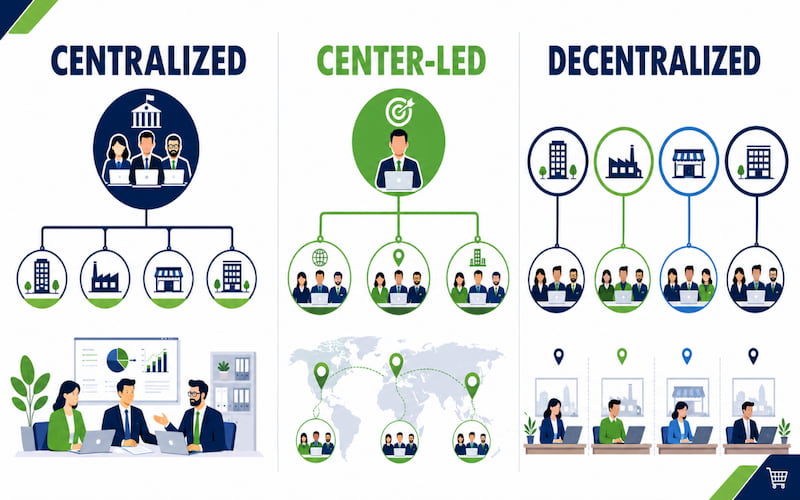
| Model | How It Works | Best Suited To |
| Centralised | One team manages policies, suppliers, categories, and major contracts | Businesses seeking consistency and consolidated buying power |
| Centre-led | A central team sets strategy while regional or business-unit teams execute locally | Multi-region companies needing control and local responsiveness |
| Decentralised | Regions or business units manage their own procurement activities | Diverse organisations with substantially different markets and requirements |
Centralised Procurement
A centralised structure can consolidate spending, reduce duplicated suppliers, and create consistent policies.
Its main limitation is speed. Local teams may struggle to respond quickly when all decisions require approval from a central office.
Centre-Led Procurement
A centre-led model gives the central team ownership of strategy, governance, major contracts, and data standards. Regional teams then manage suppliers and operational requirements within that framework.
This model often suits companies sourcing across Southeast Asia because local teams can handle factory communication, inspections, and production issues without losing central commercial oversight.
Decentralised Procurement
Decentralised procurement gives regions or business units greater authority to manage their own suppliers and purchasing decisions.
It can improve local responsiveness, but it may also create duplicated suppliers, inconsistent contracts, limited spend visibility, and weaker purchasing leverage.
How Can You Build a Procurement Team From Scratch?
1. Assess Current Spending and Suppliers
Begin by reviewing what the company buys, who it buys from, how orders are approved, and where problems occur.
Identify major categories, strategic suppliers, active contracts, recurring quality issues, delivery problems, and unmanaged spending. Speak with finance, operations, marketing, product, and logistics teams to understand how procurement currently supports or slows the business.
2. Define the Team’s Priorities
A new team should not try to fix every category and process immediately.
Initial priorities may include improving purchasing control, finding qualified suppliers, reducing total cost, strengthening quality assurance, managing risk, or supporting product development.
The priorities should reflect the company’s most important commercial and operational problems.
3. Select the Operating Model
Choose whether procurement will be centralised, centre-led, or decentralised.
The decision should consider supplier locations, category differences, approval requirements, local market knowledge, and how quickly regional teams need to respond.
4. Hire the Core Roles
The first hire should address the biggest capability gap.
A Procurement Manager may be the right starting point when the company lacks supplier strategy, governance, negotiation, and commercial control. A Buyer or Procurement Agent may be more suitable when the strategy already exists but routine purchasing and supplier follow-ups are overwhelming the team.
5. Standardise Processes and Data
Define how supplier onboarding, quotation requests, evaluations, approvals, contracts, purchase orders, quality checks, and performance reviews should work.
Supplier names, product identifiers, currencies, units of measurement, and category codes should also be standardised before complex technology is introduced.
6. Measure and Improve Performance
Procurement should report outcomes that matter to the wider business.
Useful KPIs include total landed cost, supplier quality, on-time delivery, contract coverage, purchase order cycle time, supplier concentration, risk actions, and stakeholder satisfaction.
The dashboard should remain focused. Tracking too many metrics can hide the issues that require action.
How Should Team Size Be Decided?
There is no universal ratio between procurement headcount and annual spending.
Two companies with similar spending may need very different teams. A business purchasing a small number of standard products from established suppliers requires less support than one managing custom merchandise, frequent campaigns, multiple factories, inspections, and international delivery.
Team size should reflect:
- Category and product complexity
- Number of orders and suppliers
- Geographic coverage
- Quality and compliance requirements
- Supplier maturity
- Technology and process quality
Headcount should be reviewed when managers spend too much time processing transactions or when operational employees are expected to make strategic decisions beyond their authority.
How Is AI Changing Procurement Team Design?

AI can support routine and analytical procurement activities, including spend classification, document review, RFQ preparation, quotation comparison, purchase order creation, contract data extraction, and supplier risk monitoring.
However, AI output still requires review. Incomplete specifications, weak supplier data, and unclear approval controls can produce unreliable recommendations.
As more routine tasks become automated, Buyers and Procurement Agents can spend more time managing exceptions, resolving supplier issues, reviewing data, and supporting sourcing projects.
Managers can use AI-supported analysis for category planning, supplier comparisons, negotiations, and risk reviews. They remain responsible for final decisions, supplier relationships, contracts, and commercial accountability.
The goal should not be to remove as many employees as possible. Technology should be used where it improves speed and consistency while allowing experienced people to focus on higher-value work.
What Common Mistakes Weaken Procurement Teams?

Hiring Before Responsibilities Are Defined
Adding employees without clarifying ownership can create duplicated work and gaps in accountability.
The business should define who approves suppliers, negotiates contracts, manages production, reviews quality, and handles delivery issues before expanding the team.
Focusing Only on Supplier Price
Savings matter, but procurement also influences quality, availability, working capital, compliance, risk, and customer deadlines.
A lower quotation creates little value when it leads to defects, delays, or higher freight costs.
Introducing Technology Before Fixing Data
AI and procurement platforms depend on accurate supplier, product, contract, and order information.
Technology should support a clear process rather than become a substitute for one.
Disconnecting Regional and Central Teams
Local sourcing teams need access to central specifications, contracts, forecasts, budgets, and commercial priorities.
A clearly documented procurement team structure helps define how managers, buyers, specialists, analysts, and external providers should work together.
Relying Too Heavily on One Supplier
Supplier consolidation can improve leverage and simplify management, but excessive dependency creates continuity risk.
Critical categories should have realistic alternatives and escalation plans.
Should Procurement Be In-House, Outsourced, or Hybrid?
| Model | Advantages | Limitations |
| In-house | Direct control, internal knowledge, and close stakeholder access | Requires recruitment, systems, regional expertise, and management capacity |
| Outsourced | Faster access to specialist capabilities and supplier networks | Requires clear governance and defined decision rights |
| Hybrid | Keeps strategy and approval internal while using external execution support | Depends on strong communication and clear ownership |
An in-house team may be appropriate when procurement is continuous, strategically important, and supported by sufficient scale.
External support may be useful when the business needs local sourcing knowledge, product development, quality inspections, engineering, or project-based capacity.
A hybrid structure allows internal leaders to retain budgets, supplier approvals, category strategy, and stakeholder relationships while using external specialists for defined activities.
Businesses still defining the full procurement process should first clarify which responsibilities belong to strategy, sourcing, purchasing, quality, and delivery.
It is also important to distinguish between finding suppliers and managing the full procurement lifecycle. Refer to our blog on sourcing vs procurement for a clearer explanation of where the responsibilities differ.
How Does UCT Asia Support Procurement Teams?
UCT (Asia) can support internal teams when additional product, sourcing, engineering, production, or regional execution capabilities are required.
Its service model covers product design, prototyping, sourcing, procurement, mass production, quality assurance, fulfilment, and logistics. This allows the client’s internal procurement team to retain strategic and client-facing responsibilities while using additional operational capabilities where needed.
Support can also continue after production through quality assurance, fulfilment, and logistics, including inspections, warehousing, pick-and-pack services, dispatching, tracking, and documentation.
Conclusion
An effective procurement team needs the right balance of strategy, execution, supplier knowledge, data, and regional expertise. Businesses should begin by defining their priorities and responsibilities, then select an operating model, hire the core roles, standardise processes, and introduce technology where it supports measurable results.
At UCT (Asia), we specialise in POS merchandise, displays, serving materials, loyalty gifts, promotional products, retail items, printed materials, on-packs, and corporate gifts. We support leading promotional companies, marketing procurement teams, and fulfilment agencies from product creation and prototyping through manufacturing and delivery, with integrated design, R&D, sourcing, engineering, and production capabilities across Asia and the United States.
Frequently Asked Questions
What Makes a Successful Procurement Team?
A successful procurement team combines clear priorities, defined responsibilities, capable people, reliable supplier data, effective processes, and strong stakeholder relationships.
It should improve cost, quality, delivery, compliance, and risk rather than focusing only on purchase prices.
What Roles Should a Small Procurement Team Include?
A small team may begin with an experienced Procurement Manager supported by a Buyer, Procurement Agent, or Coordinator.
Analytical, quality, contract, and specialist sourcing responsibilities can initially be shared or supported externally.
How Many People Should Be in a Procurement Team?
There is no universal team-size benchmark.
The required headcount depends on transaction volume, product complexity, supplier locations, quality requirements, regulations, technology, and the number of categories managed.
What Is the Difference Between Procurement and Purchasing?
Purchasing focuses mainly on transactional activities such as purchase orders, confirmations, deliveries, and invoices.
Procurement is broader and includes sourcing strategy, supplier selection, contracts, risk, quality planning, and ongoing supplier management.
What Is a Centre-Led Procurement Model?
A centre-led model combines central strategy and governance with regional or business-unit execution.
The central team may control major contracts, policies, category strategies, and data, while local teams manage supplier communication and operational requirements.
How Is AI Changing Procurement Teams?
AI can support repetitive administration, data classification, document review, supplier monitoring, and analysis.
Procurement professionals remain responsible for validating information, managing suppliers, negotiating contracts, resolving exceptions, and making accountable commercial decisions.
Should Procurement Be Outsourced?
Procurement can be outsourced fully or partially when a business needs regional supplier knowledge, quality support, specialist capabilities, or additional project resources.
Strategy, budgets, approval authority, and accountability should remain clearly defined regardless of the operating model.