
The decision between hiring an in-house procurement team and working with a procurement company is no longer based on business size alone.
Companies must consider category complexity, supplier locations, internal expertise, procurement technology, quality requirements, and the amount of control they need. A business sourcing custom products from several Asian markets may require a different model from one purchasing standard services from established domestic suppliers.
AI is also changing the calculation. It can support repetitive procurement activities, but companies still need people who understand suppliers, specifications, contracts, risk, and commercial priorities.
This article compares procurement companies with in-house teams and explains when outsourcing, internal hiring, or a hybrid structure may be the better choice.
What Is a Procurement Company?
A procurement company is an external provider that manages selected procurement activities on behalf of another business.
Its services may include:
- Supplier research and qualification
- RFQ or RFP management
- Product development and sampling
- Commercial negotiation
- Production coordination
- Quality inspections
- Supplier performance monitoring
- Warehousing, fulfilment, and logistics
The provider may manage one project, one purchasing category, or a broader procurement programme. Responsibility should be defined clearly because some providers focus only on supplier sourcing, while others support the complete process from product development through delivery.
Common engagement models include project-based sourcing, ongoing procurement outsourcing, managed services, procurement consulting, and technology-supported procurement services.
What Is an In-House Procurement Team?
An in-house procurement team consists of employees who manage purchasing and supplier activities directly for the company.
A small team may include a Procurement Manager supported by one or two Buyers or Procurement Agents. Larger organisations may also employ Category Managers, Procurement Analysts, Contract Managers, Supplier Quality Specialists, and a Chief Procurement Officer.
The main advantages are direct control, close stakeholder relationships, and deeper internal knowledge. Team members can work closely with finance, operations, marketing, engineering, and other departments when making supplier decisions.
The trade-off is that the company must recruit, train, manage, and retain the team while also investing in systems, data, regional knowledge, and specialist capabilities.
How Do Procurement Companies and In-House Teams Compare?
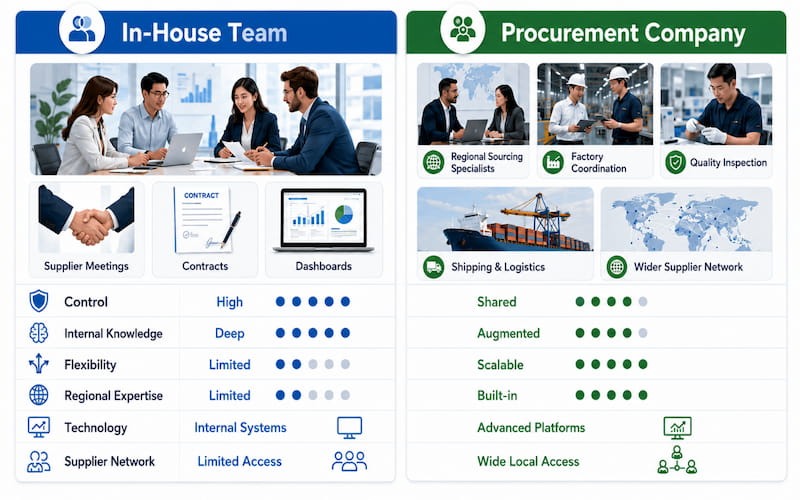
| Area | In-House Procurement Team | Procurement Company |
| Control | Direct control over suppliers, contracts, and decisions | Depends on the agreed scope and governance |
| Internal knowledge | Strong understanding of company priorities and stakeholders | Requires structured onboarding and communication |
| Regional expertise | Limited to the team’s experience and locations | May offer established regional supplier knowledge |
| Flexibility | Fixed headcount and employment costs | Can often scale by project, category, or workload |
| Supplier relationships | Developed directly by the company | May provide access to an existing supplier network |
| Technology | Selected and funded internally | May be included within the provider’s service |
| Quality control | Requires internal or third-party inspection capability | May be included when the provider operates near suppliers |
| Time to establish | Recruitment and process development may take time | Can begin more quickly when the scope is defined |
| Accountability | Managed through internal reporting lines | Must be established through contracts, KPIs, and governance |
Neither model is automatically better. The most suitable option depends on which responsibilities are strategically important and which require specialist execution.
What Costs Should Businesses Compare?
Comparing salary with a provider’s service fee does not show the complete cost of either model.

In-House Costs Extend Beyond Salary
The full cost of an internal team may include:
- Base salary and bonuses
- Employee benefits
- Recruitment and onboarding
- Training and professional development
- Procurement software licences
- Travel and supplier visits
- Office and management overhead
- Quality inspection resources
- Employee turnover and replacement
According to the U.S. Bureau of Labor Statistics, the median annual wage in May 2024 was $75,650 for buyers and purchasing agents and $139,510 for purchasing managers. These figures are occupational medians, not complete employment costs or guaranteed 2026 salaries.
External Providers Use Different Pricing Models
Procurement companies may charge through:
- A fixed project fee
- A monthly retainer
- A percentage of managed spending
- A transaction-based fee
- A share of agreed savings
- A blended model
The cheapest quoted fee is not necessarily the best value. Businesses should check which activities are included, whether supplier and production visits are covered, how quality inspections are charged, and who is responsible when problems occur.
Total Cost Should Be Compared With Total Capability
The decision should also consider the value of faster supplier access, local communication, quality control, and reduced internal workload.
A more expensive model may still offer better value if it prevents defects, supports faster product development, or reduces the need for several separate suppliers and service providers.
How Is AI Changing the Build-vs-Buy Decision?

AI can support spend classification, supplier research, RFQ preparation, document review, quotation comparison, contract analysis, purchase order workflows, and risk monitoring.
This can make a small internal team more productive. It may also allow procurement companies to manage supplier information and sourcing projects more efficiently.
However, AI does not remove the need for accurate specifications, reliable data, supplier communication, approval controls, and commercial judgement. Deloitte’s 2025 Global Chief Procurement Officer Survey found that the strongest procurement results were associated with combining digital investment and capable talent, with people remaining involved in technology-enabled decisions.
AI therefore changes the work performed by procurement teams rather than eliminating the need for them. Routine administration may require less time, while supplier management, negotiation, quality, risk, and exception handling become more important.
When Is an In-House Procurement Team the Better Choice?
An internal team may be more suitable when procurement has a direct and continuing effect on the company’s core operations.
This can include situations where:
- Categories are commercially or technically sensitive
- Supplier information must remain closely controlled
- Procurement decisions require frequent internal consultation
- The company manages significant recurring purchasing activity
- Contracts involve high operational or regulatory risk
- Supplier relationships are strategically important
- The organisation has enough scale to support specialist roles
An in-house structure also gives the company direct ownership of procurement knowledge. This can be valuable when specifications, supplier history, and negotiation strategies create a long-term competitive advantage.
The limitation is capacity. A small internal team may understand the business well but lack local supplier networks, technical product knowledge, or enough resources to manage every category effectively.
When Is a Procurement Company the Better Choice?
External procurement support may be appropriate when the company needs capabilities that would take too long or cost too much to build internally.
Examples include:
- Entering an unfamiliar supplier market
- Managing a temporary product or promotional campaign
- Sourcing from several overseas locations
- Requiring local factory communication
- Coordinating prototypes and production
- Conducting supplier audits or quality inspections
- Managing an irregular or seasonal workload
- Expanding faster than the internal team can support
A provider may also be useful for categories that are important but do not justify a permanent specialist employee.
Outsourcing works best when the scope is clear. The client should retain approval over important suppliers, specifications, budgets, and contractual commitments unless another arrangement has been agreed explicitly.
When Does a Hybrid Procurement Model Work Best?
A hybrid model combines internal control with external execution.
The company may retain category strategy, budgets, approvals, and major supplier relationships internally. The external provider then supports supplier identification, sampling, factory coordination, inspections, production follow-ups, or delivery.
This model can give the business closer control than full outsourcing while avoiding the need to build every regional or technical capability internally.
For example, an internal Procurement Manager may define the product requirements and approve suppliers. An external team near the factories can then coordinate samples, monitor production, inspect finished goods, and support delivery.
A hybrid structure usually works best when:
- Strategy is important enough to remain internal
- Execution requires specialist or regional expertise
- Procurement volume changes throughout the year
- Several product and delivery partners would otherwise need coordination
- The company wants to expand without immediately increasing permanent headcount
Which Model Fits Different Industries?
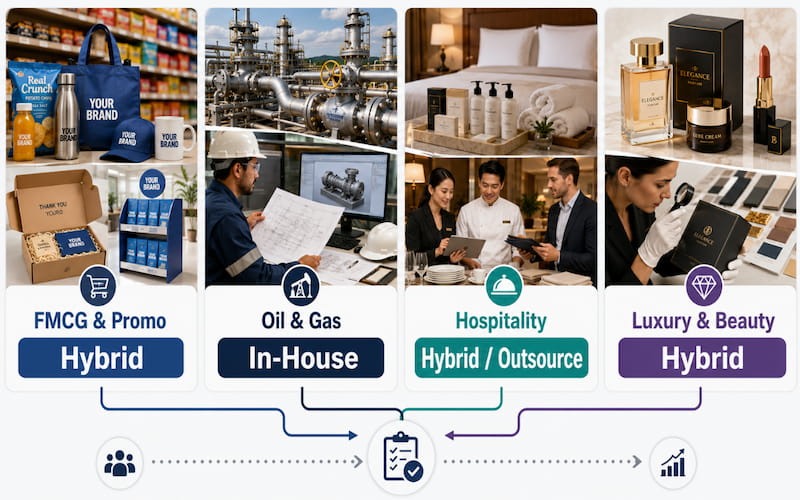
FMCG and Promotional Merchandise Often Suit a Hybrid Model
FMCG, branded merchandise, and promotional campaigns frequently involve custom product development, packaging, samples, several factories, and fixed campaign deadlines.
An internal brand or procurement lead can retain control of specifications, budget, and campaign requirements, while external specialists manage production and supplier coordination.
Businesses managing consumer goods procurement should also evaluate whether their provider understands branded products, retail displays, packaging, and the operational requirements of high-volume campaigns.
Oil and Gas Procurement Usually Requires Strong Internal Control
Oil and gas, manufacturing, and industrial procurement may involve detailed technical specifications, critical equipment, regulated processes, and long-term supplier relationships.
The company may need internal category and engineering expertise, supported by external sourcing or inspection resources for selected projects.
For oil and gas procurement, the decision should reflect technical risk, supplier qualification, documentation, quality requirements, and the operational consequences of delays or defects.
Hospitality Can Benefit From Regional Execution Support
Hospitality procurement may include serving materials, amenities, branded merchandise, uniforms, displays, and guest-facing products.
An internal team understands the brand standards and operational requirements. A regional procurement company can support supplier sourcing, samples, production, inspections, and consolidation across multiple properties or markets.
Luxury and Health and Beauty Require Product and Quality Expertise
Luxury, beauty, and premium consumer products often require close control of materials, finishes, colours, packaging, and brand presentation.
A hybrid model may allow the company to retain design approval and supplier strategy internally while using specialist product developers, engineers, and quality personnel during execution.
What Risks Should Be Managed?
Loss of Control
A poorly defined outsourced arrangement may leave the company uncertain about supplier decisions, costs, or production status.
Contracts should clarify approval rights, reporting frequency, and escalation procedures.
Confidentiality and Intellectual Property
Product specifications, supplier pricing, and new concepts may be commercially sensitive.
NDAs, controlled access, intellectual property clauses, and clear ownership of designs and tooling should be agreed before information is shared.
Supplier Conflicts
A procurement provider may work with several clients in the same sector.
Businesses should ask how supplier information, pricing, and confidential projects are separated.
Quality Responsibility
Outsourcing supplier communication does not automatically protect product quality.
The agreement should state who approves samples, defines tolerances, inspects production, manages defects, and pays for corrective action.
Internal Dependency
An external provider should not become the only place where supplier and product information is stored.
The client should retain access to contracts, specifications, supplier records, inspection reports, and project history.
Businesses assessing procurement partners should review governance and accountability as carefully as pricing and supplier access.
How Can You Choose the Right Procurement Model?
Start with the work that needs to be performed rather than assuming the answer from company size.
Consider these questions:
- Which categories are strategically important?
- Does the business already have capable procurement leadership?
- Are the suppliers located in markets where local support is needed?
- How frequently does the purchasing workload change?
- Does the company have internal quality and technical expertise?
- How sensitive are the product, pricing, and supplier details?
- Can existing technology and data support the chosen model?
- Who must approve suppliers, contracts, and production?
- What would happen if the provider or an internal employee became unavailable?
- Which model provides the clearest accountability for the final outcome?
A business with strong strategic procurement but limited regional execution may benefit from a hybrid structure. A company with no organised process may first need external support to establish control. A large organisation with complex recurring categories may be better served by a mature internal procurement team supported by specialist providers.
How Should the Selected Model Be Implemented?
Establish the Scope
Define which categories, suppliers, countries, and activities are included.
The agreement should distinguish between strategic decisions, operational work, and final approval.
Set Decision Rights
Document who can approve suppliers, pricing, samples, contracts, purchase orders, production changes, and corrective actions.
A RACI matrix can help separate who is Responsible, Accountable, Consulted, and Informed.
Agree on KPIs
Relevant measures may include:
- Total landed cost
- Supplier quality
- On-time delivery
- Product development lead time
- RFQ turnaround
- Documentation accuracy
- Contract compliance
- Corrective action response time
Savings should not be the only measure because lower purchasing prices can create higher quality, freight, or inventory costs.
Begin With a Controlled Scope
A project, category, or regional pilot allows the company to test communication, reporting, supplier performance, and governance before expanding the arrangement.
Keep Procurement Data Accessible
Supplier records, specifications, quotations, purchase orders, contracts, inspection reports, and delivery information should remain visible to the client.
This is important whether procurement is internal, outsourced, or hybrid.
How Does UCT Asia Support Procurement Teams?
UCT (Asia) supports clients through product design, engineering, prototyping, sourcing, procurement, merchandising, mass production, quality inspection, fulfilment, and logistics. Its process is organised across product creation, sourcing and manufacturing, followed by quality assurance and delivery support.
This model can complement an internal procurement function when additional product, supplier, engineering, manufacturing, or regional execution capability is required.
The client can retain responsibility for campaign strategy, specifications, budgets, and approvals while UCT (Asia) supports product development and execution across the agreed project scope.
Conclusion
The right procurement model depends on the work being managed, not company size alone. In-house teams provide close control and internal knowledge. Procurement companies can offer flexibility, regional expertise, and additional execution capacity. Hybrid models combine both by keeping strategic decisions internal while using external specialists where they add the greatest value.
Businesses should compare total capability, risk, governance, and accountability rather than focusing only on salary or service fees. The best structure is the one that gives every supplier decision, product requirement, and production stage clear ownership.
At UCT (Asia), we specialise in POS merchandise, displays, serving materials, loyalty gifts, promotional products, retail items, printed materials, on-packs, and corporate gifts. We support leading promotional companies, marketing procurement teams, and fulfilment agencies from product creation and prototyping through manufacturing and delivery, with integrated design, R&D, sourcing, engineering, and production capabilities across Asia and the United States.
Frequently Asked Questions
Is It Cheaper to Outsource Procurement or Build an In-House Team?
It depends on the required team size, category complexity, supplier locations, technology, and workload.
Outsourcing may avoid permanent employment and system costs, while an internal team may provide better value when purchasing is continuous, complex, and strategically important.
What Is In-House Procurement?
In-house procurement is managed by employees of the company. The internal team may handle sourcing strategy, supplier selection, contracts, purchase orders, performance, quality, and risk.
When Should a Company Outsource Procurement?
Outsourcing may be appropriate when the company needs regional supplier access, specialist product knowledge, temporary capacity, quality inspection, or support in an unfamiliar market.
What Is a Hybrid Procurement Model?
A hybrid model keeps selected responsibilities within the company while assigning other activities to an external provider.
For example, the internal team may control strategy and approvals while the provider manages supplier sourcing, production follow-ups, and inspections.
What Are the Main Risks of Procurement Outsourcing?
The main risks include unclear control, confidentiality concerns, provider dependency, supplier conflicts, inconsistent reporting, and weak quality accountability.
These risks can be reduced through clear contracts, decision rights, KPIs, information access, and regular reviews.
How Should a Procurement Company Be Evaluated?
Review its category experience, supplier network, regional presence, quality procedures, reporting, data controls, references, and ability to manage problems.
The evaluation should also confirm which activities are included and who remains accountable for final decisions.
Does AI Remove the Need for an Internal Procurement Team?
No. AI can reduce repetitive work and support analysis, but companies still need people to verify data, manage suppliers, negotiate terms, control risk, and approve commercial decisions.
What Is the Difference Between Procurement Outsourcing and Consulting?
Procurement consulting usually focuses on advice, strategy, or transformation for a defined period.
Procurement outsourcing involves ongoing responsibility for selected procurement activities or categories.
Should a Small Business Hire Internally or Outsource?
A smaller business may benefit from outsourcing when it lacks enough procurement work to justify a full team or needs specialist regional support.
An internal hire may be more suitable when procurement is continuous and closely connected to daily operations.