
Maximizing Impact: The Essential Guide to Campaign Merchandise for Political Candidates [2026]
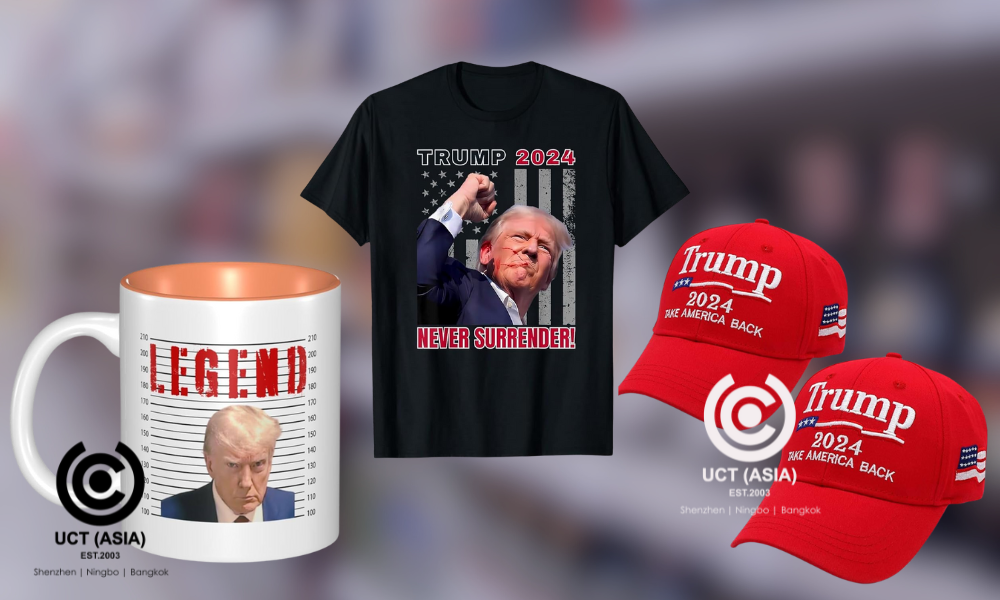
Political campaigns no longer operate as simple messaging machines; they function as multi-channel behavioral influence systems where every touchpoint shapes perception, identity, and action. Campaign merchandise sits at the center of this system, transforming passive supporters into active signal amplifiers.
A shirt, a sticker, or a yard sign does more than display a name. It encodes identity, signals affiliation, and triggers social proof loops that ripple through communities. When a supporter wears campaign apparel, three processes activate simultaneously: visibility increases, familiarity builds, and trust forms through repeated exposure.
Statista reports that repeated exposure to political messaging significantly increases recognition and favorability, especially in local races where name recognition often determines outcomes. Campaign merchandise accelerates this effect by embedding the message into daily life rather than limiting it to paid media slots.
Instead of treating merchandise as promotional extras, high-performing campaigns engineer it as a distributed media channel that blends branding, fundraising, and behavioral psychology into one system.
Behavioral Mechanics Behind Campaign Merchandise
1.1 Identity Signaling and Group Formation
When individuals display campaign merchandise, they publicly declare affiliation. That action transforms private preference into visible identity.
Behavioral research from MIT (2023) shows that individuals who make small public commitments, such as wearing branded items, are significantly more likely to maintain consistent behavior later, including voting and donating.
This creates a reinforcing loop:
- Ownership → Identity reinforcement
- Identity → Increased advocacy
- Advocacy → Social influence
A voter wearing a campaign shirt does not just support a candidate. They become part of a visible network of supporters, making the campaign feel larger and more legitimate.
1.2 Social Proof Amplification
Humans interpret popularity as credibility. When people repeatedly see others displaying support, they infer viability.
Merchandise operationalizes this through everyday exposure:
- A commuter wearing a campaign cap
- A neighbor displaying a yard sign
- A student with a sticker-covered laptop
Each interaction signals, “Others support this candidate,” which lowers resistance among undecided voters.
Research published in the Journal of Political Marketing indicates that perceived popularity can increase voter support by up to 15% in competitive local elections.
1.3 Cognitive Anchoring and Recall
Visual repetition builds mental shortcuts. Campaign merchandise ensures that a candidate’s name appears in multiple contexts: streets, homes, workplaces, and social gatherings.
This repeated exposure creates cognitive anchors, making the candidate easier to recall during decision-making moments.
A Nielsen study on advertising recall found that physical and environmental cues produce longer-lasting memory retention than digital impressions alone. Merchandise leverages this by embedding branding into real-world environments.
Merchandise as a Revenue Engine
2.1 From Expense to Self-Funding System
Traditional campaign spending consumes budget. Merchandise reverses this dynamic by generating revenue while expanding reach.
Campaign finance data shows that well-executed merchandise programs contribute between $50,000 and $500,000+ depending on race scale .
This creates a dual-output system:
- Financial return
- Marketing exposure
2.2 The Micro-Commitment Effect
Purchasing merchandise signals deeper engagement than passive support. Behavioral economists describe this as a commitment escalation pathway:
- Step 1: Follow campaign
- Step 2: Buy merchandise
- Step 3: Donate
- Step 4: Vote
- Step 5: Advocate
Each step increases psychological investment. A supporter who spends money becomes more likely to justify that decision by staying loyal to the campaign.
2.3 Pricing Strategy and Perceived Value
Successful campaigns structure merchandise pricing to balance accessibility and contribution value:
| Tier | Example Items | Behavioral Role |
|---|---|---|
| Entry ($5–15) | Stickers, buttons | Mass adoption, visibility |
| Mid ($20–40) | T-shirts, caps | Identity reinforcement |
| Premium ($50–100+) | Hoodies, bundles | High commitment, fundraising |
Limited-edition releases introduce scarcity, which increases urgency and conversion rates. Campaigns that launch time-bound drops often see rapid sell-outs due to perceived exclusivity.
Designing Merchandise That Converts
3.1 Color Psychology as Messaging Infrastructure
Color selection communicates emotion before words register. Campaigns use color systems to shape perception instantly:
- Red triggers urgency and energy
- Blue signals trust and stability
- Green connects to growth and environmental focus
- Black conveys authority and sophistication
Research in visual cognition shows that consistent color usage improves brand recognition by up to 80%. Campaigns that maintain a tight palette of 2–3 colors achieve faster recall and stronger visual identity.
3.2 Typography and Instant Readability
Campaign merchandise operates in motion. People see it while walking, driving, or scrolling quickly.
Sans-serif fonts such as Helvetica and Arial improve readability at distance because they reduce visual noise.
Effective hierarchy follows a strict structure:
- Candidate name dominates
- Slogan supports
- Office or affiliation remains secondary
Short slogans under six words perform best because they compress meaning into a format the brain processes instantly.
3.3 Logo Systems and Scalability
A campaign logo must function across multiple surfaces:
- Fabric
- Paper
- Digital screens
- Large-scale signage
Strong logos maintain clarity whether printed on a small button or a highway billboard. Simplicity ensures adaptability, while distinctiveness ensures memorability.
Product Strategy: Turning Supporters into Media Channels
Different merchandise types activate different behavioral pathways.
4.1 High-Visibility Assets
- T-shirts transform supporters into mobile advertisements
- Yard signs create persistent neighborhood presence
These items deliver sustained exposure with minimal additional cost.
4.2 Viral Low-Cost Items
- Stickers spread rapidly across personal objects
- Buttons encourage event-based participation
Low production cost allows mass distribution, increasing reach exponentially.
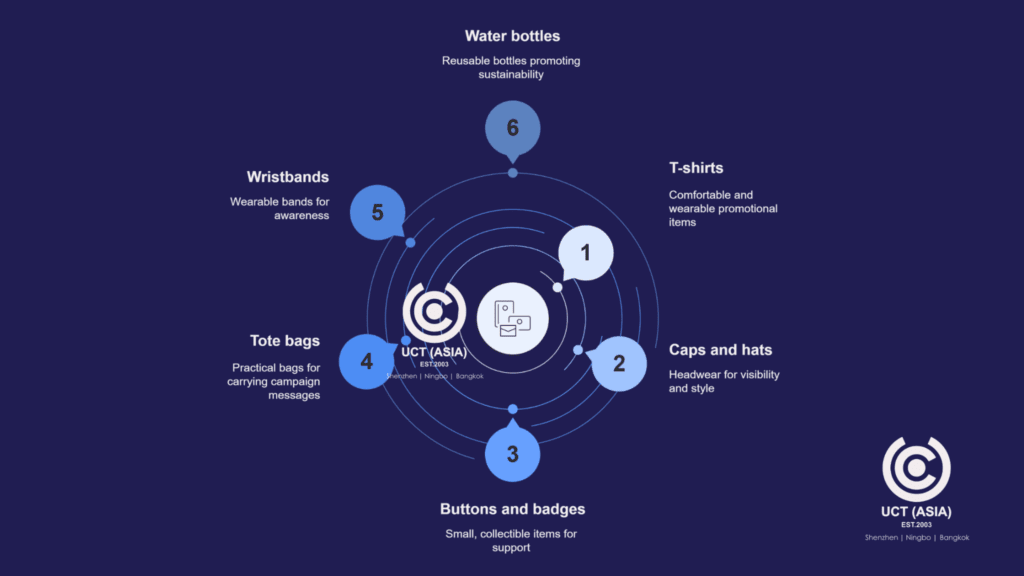
4.3 Functional Everyday Items
- Tote bags
- Water bottles
- Wristbands
These integrate into daily routines, extending exposure duration beyond campaign events.
The most effective campaigns combine all three categories, creating layered visibility across environments.For larger races, scale proportionally while maintaining similar percentages.
Cost Efficiency and Media Comparison
Campaign merchandise consistently outperforms traditional advertising in cost efficiency.
| Channel | Cost per 1,000 Impressions | Limitation |
|---|---|---|
| TV Ads | $20–50 | Declining viewership |
| Digital Ads | $5–25 | Ad fatigue, blocking |
| Direct Mail | $100–300 | High cost |
| Apparel | $0.50–2.00 | Requires adoption |
| Stickers | $0.10–0.50 | Limited message space |
Merchandise achieves lower costs because it converts supporters into distribution nodes. Instead of paying for every impression, campaigns leverage voluntary exposure.
6. Distribution Systems That Scale Influence
6.1 Event-Based Amplification
Rallies, parades, and canvassing operations provide concentrated distribution opportunities.
- Apparel creates visual unity in crowds
- Signs enhance media coverage
- Giveaways extend reach beyond attendees
6.2 Digital Commerce Infrastructure
Online stores extend campaign reach beyond geographic limitations.
Key optimization strategies include:
- Limiting product selection to 8–12 items
- Offering bundles to increase order value
- Providing clear sizing and product visuals
Campaigns that integrate e-commerce effectively convert enthusiasm into measurable revenue and data collection.
6.3 Incentivized Distribution
Linking merchandise to donations increases both metrics simultaneously:
- $25 donation → sticker pack
- $50 donation → T-shirt
- $100+ donation → premium item
This transforms fundraising into a transactional exchange rather than a purely financial request.
Manufacturing Strategy and Operational Efficiency
Large-scale campaigns leverage global manufacturing to optimize cost structures.
Asian production hubs reduce costs by 40–60% through economies of scale and material sourcing efficiencies .
Production timelines typically follow:
- Standard: 3–4 weeks
- Rush: accelerated with premium costs
Quality control remains critical:
- Accurate color matching ensures brand consistency
- Durable materials maintain long-term visibility
- Consistent sizing prevents supporter dissatisfaction
Campaigns that fail in quality risk negative perception, which can undermine the intended message.
8. Merchandise as a Feedback Loop System
The most advanced campaigns treat merchandise as a continuous feedback loop rather than a one-time output.
System Flow:
- Design merchandise aligned with identity
- Distribute through events and online channels
- Supporters display items publicly
- Visibility increases social proof
- New supporters engage and purchase
- Revenue funds further expansion
This loop compounds over time, creating exponential growth in both visibility and engagement.
9. Strategic Differentiation Through Cultural Relevance
Campaigns that achieve viral success often tap into cultural moments.
When merchandise aligns with existing conversations, it spreads organically across social platforms and communities. Timing, humor, and emotional resonance drive this effect.
A single well-designed item can generate millions of impressions if it connects with broader cultural narratives.
10. Audience Segmentation and Product Alignment
Different voter groups respond to different merchandise types:
- Younger voters prefer expressive and shareable items such as hoodies and stickers
- Middle-aged voters gravitate toward practical items like tote bags and drinkware
- Older voters respond to traditional formats such as caps and yard signs
- High-value donors prefer premium and limited-edition items
Aligning merchandise with audience preferences increases adoption rates and overall campaign effectiveness.
11. Interactive Reflection
Consider this:
If a campaign spends $10,000 on digital ads, the exposure ends when the budget runs out.
If the same $10,000 produces merchandise worn daily by supporters, how long does that visibility last?
Days turn into weeks. Weeks turn into months. Each item continues generating impressions without additional cost.
Now scale that across hundreds or thousands of supporters. The campaign effectively builds a self-sustaining media network powered by its own voters.
12. Expanding the Strategic Model
Campaign merchandise no longer fits into a single category. It operates simultaneously as a branding system, a fundraising engine, a behavioral influence mechanism, and a distributed media channel that scales through supporter participation rather than paid reach. Campaigns that recognize this multidimensional role build infrastructure that compounds visibility, engagement, and revenue over time, while those that overlook it leave significant influence untapped in competitive environments. The next evolution of political strategy lies in treating merchandise not as output but as an integrated system, and partnering with a specialized branding Merchandise agency enables campaigns to execute this system with precision, consistency, and measurable impact across every voter touchpoint.