
The difference between procurement and supply chain management has become increasingly important for businesses managing international suppliers, production, and distribution.
When the two functions are poorly aligned, companies may face longer lead times, higher landed costs, inconsistent supplier communication, quality issues, and limited supply chain visibility. Asia-focused brands sourcing branded merchandise, on-pack marketing materials, POSM, and custom products experience this relationship directly because supplier decisions affect production, freight, and final delivery.
This guide explains the key differences between procurement and supply chain management, where procurement fits within the supply chain lifecycle, and how businesses can coordinate both functions more effectively.
What Is Procurement and Supply Chain Management?
Procurement Focuses on Acquiring Goods and Services
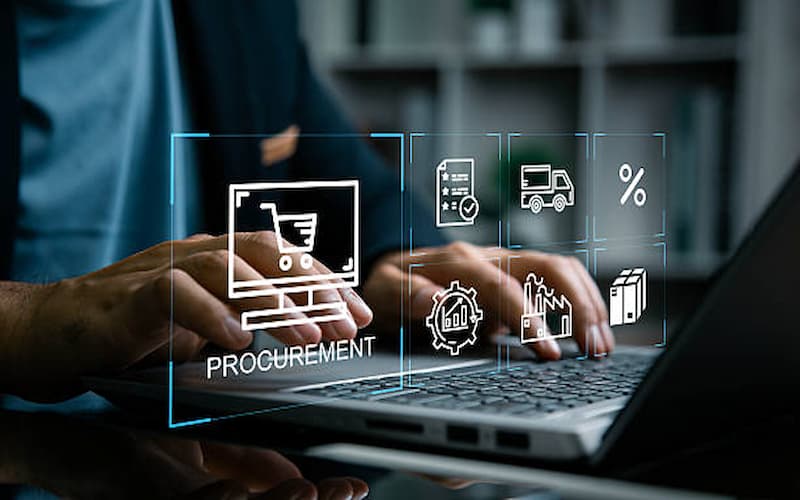
Procurement covers the activities involved in sourcing and purchasing goods or services from external suppliers. It typically includes:
- Identifying business requirements
- Researching and evaluating suppliers
- Running RFQ and RFP processes
- Negotiating prices and contracts
- Issuing purchase orders
- Managing supplier relationships
- Monitoring cost, quality, and performance
Its core question is: Who should we buy from, under what terms, and at what cost?
Supply Chain Management Coordinates the Full Product Flow

Supply chain management, or SCM, coordinates the movement of goods, information, and finances from raw materials through production and final delivery.
It commonly includes procurement, production planning, inventory management, warehousing, transportation, distribution, demand forecasting, and returns.
Its core question is: How do we deliver the right product to the right place, at the right time, cost, and quality?
Procurement is therefore one function within supply chain management, although some companies operate it as a separate department. IBM also defines procurement as a subset of the wider supply chain management process.
How Do Procurement and Supply Chain Management Compare?
| Dimension | Procurement | Supply Chain Management |
| Scope | Sourcing, purchasing, contracts, and supplier management | Procurement, production, inventory, logistics, and distribution |
| Time horizon | Individual orders to long-term supplier agreements | Continuous operational and strategic planning |
| Main stakeholders | Suppliers, internal requesters, finance, and legal teams | Suppliers, manufacturers, logistics providers, sales teams, finance, and customers |
| Core KPIs | Cost savings, supplier performance, contract compliance, and PO cycle time | OTIF delivery, landed cost, inventory turns, forecast accuracy, and lead time |
| Main decisions | Supplier selection, pricing, commercial terms, and contract awards | Production capacity, inventory, transportation, routes, and distribution |
| Technology | eSourcing, procure-to-pay, contract management, and spend analytics | ERP, TMS, WMS, demand planning, and shipment visibility systems |
| Primary risk | Supplier failure, price changes, contract exposure, and quality issues | Supply disruption, inventory imbalance, transport delays, and demand variability |
| Career path | Buyer → Procurement Manager → Procurement Director → CPO | Supply Chain Analyst → Manager → Director → CSCO |
What Are the Seven Key Differences Between Procurement and SCM?
1. Procurement Has a Narrower Scope
Procurement focuses primarily on sourcing, supplier selection, commercial terms, purchasing, and supplier performance.
SCM covers the wider flow. It includes procurement but extends into production, inventory, warehousing, freight, distribution, and returns.
For example, selecting a factory to produce 100,000 branded bar mats is procurement. Coordinating their production and delivery to thousands of locations is supply chain management.
2. The Functions Work With Different Stakeholders
Procurement works closely with suppliers, finance, legal teams, and internal departments requesting products or services.
SCM works with these groups as well as production teams, warehouses, freight forwarders, customs specialists, distributors, retailers, and customers.
A procurement manager may focus on factory pricing, specifications, and minimum order quantities. An SCM manager must also consider freight capacity, warehouse space, inventory requirements, and delivery deadlines.
3. Procurement Creates Supplier Value While SCM Optimises Flow
Procurement strategy asks whether the company is working with the right suppliers, receiving competitive terms, and managing supplier risk effectively.
SCM strategy focuses on moving products through the complete chain with minimal delay, waste, and unnecessary cost.
A lower factory price does not always create a lower total cost. If the selected supplier causes more defects, longer lead times, or expensive freight requirements, the initial saving may be lost elsewhere in the supply chain.
4. Procurement and SCM Use Different Planning Horizons
Procurement works across short-term transactions and long-term supplier relationships. A purchase order may be completed within weeks, while a strategic supplier agreement may remain active for several years.
SCM operates continuously. Demand, production capacity, inventory, shipments, and delivery schedules must be monitored throughout the year.
This is why supplier contracts must reflect production and distribution requirements rather than focusing on price alone.
5. Performance Is Measured Differently
Procurement KPIs commonly include:
- Cost savings and cost avoidance
- Supplier on-time delivery
- Contract compliance
- Purchase order cycle time
- Supplier quality
- Spend under management
SCM KPIs commonly include:
- On-time-in-full delivery
- Total landed cost
- Inventory turns
- Forecast accuracy
- Cash-to-cash cycle time
- Perfect order rate
Procurement measures the value and performance of the purchase. SCM measures how effectively the entire product flow operates.
6. Each Function Uses Different Technology
Procurement technology supports sourcing and purchasing. This can include eSourcing platforms, supplier databases, contract management systems, spend analytics, and procure-to-pay tools.
SCM technology supports planning and execution across the wider chain. It can include ERP systems, transportation management systems, warehouse management systems, demand planning, inventory optimisation, and shipment tracking.
The systems should connect around purchase orders, supplier confirmations, production schedules, shipment dates, and invoices.
7. SCM Requires Broader Relationship Management
Procurement relationship management is mainly supplier-facing. Procurement professionals negotiate with factories, material suppliers, and service providers.
SCM relationship management extends further. It includes suppliers, internal teams, logistics providers, warehouses, distributors, retailers, and customers.
Procurement manages the commercial relationship, while SCM coordinates the parties required to complete the order.
Where Does Procurement Fit Within the SCM Lifecycle?
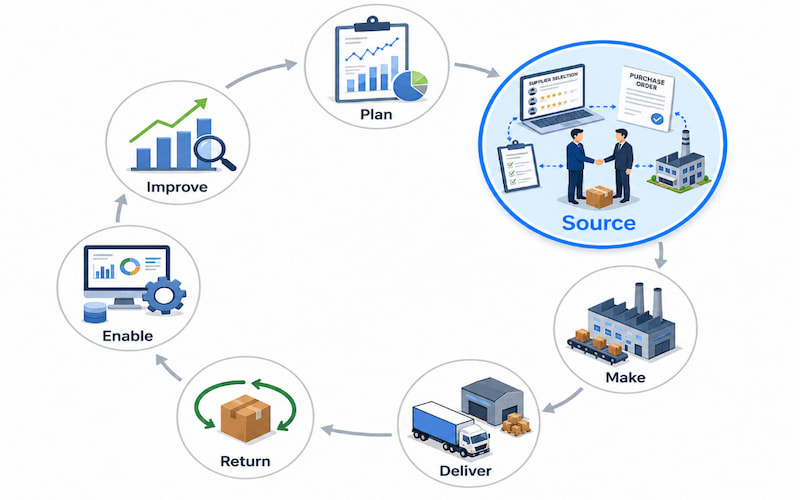
The ASCM SCOR Digital Standard organises supply chain management around seven primary processes: Orchestrate, Plan, Order, Source, Transform, Fulfil, and Return. Procurement has its strongest ownership within Source but also contributes to the other stages.
| SCM Process | Procurement’s Role | SCM’s Wider Role |
| Orchestrate | Supplier governance, contracts, and sourcing policies | Align the full network, data, people, and performance |
| Plan | Provide supplier cost, capacity, and lead-time data | Balance demand, inventory, capacity, and resources |
| Order | Manage purchase orders and supplier confirmations | Coordinate orders across the supply chain |
| Source | Lead supplier research, RFQs, negotiation, and purchasing | Connect sourcing decisions with operational plans |
| Transform | Support supplier production and issue resolution | Manage manufacturing, assembly, and packaging |
| Fulfil | Define delivery terms and monitor suppliers | Manage warehousing, transportation, customs, and delivery |
| Return | Manage supplier claims and corrective action | Coordinate returns, replacements, repair, and disposal |
In some companies, procurement reports to the supply chain leader. In others, procurement and SCM operate as separate departments.
The right structure depends on company size, product complexity, spending, geographic coverage, and strategic priorities.
Why Is the Difference Clear in Branded Merchandise?

Branded merchandise, on-pack marketing, POSM, and custom promotional products make the difference between procurement and SCM particularly visible.
Consider a beverage company ordering 100,000 branded neon signs.
Procurement would normally:
- Define the product specification
- Identify qualified suppliers
- Request and compare quotations
- Evaluate samples
- Negotiate pricing and payment terms
- Agree on quality standards
- Issue the purchase order
SCM would then:
- Coordinate the production schedule
- Arrange quality inspections
- Book freight
- Prepare shipping documentation
- Manage customs clearance
- Allocate inventory
- Coordinate final delivery
An integrated approach reduces handovers and gives both teams visibility over specifications, costs, production progress, quality, and delivery dates.
According to PPAI, U.S. promotional products distributor sales reached $27.1 billion in 2025. This figure represents the U.S. promotional products market rather than the total global branded merchandise industry.
How Do Asian Manufacturers Experience Procurement and SCM?
From an Asian manufacturer’s perspective, procurement and SCM create different requirements.
The procurement contact usually manages specifications, quotations, samples, contracts, and commercial matters. The SCM team coordinates production schedules, freight, customs documents, inventory allocation, and delivery.
Problems occur when procurement and SCM provide conflicting instructions. Procurement may request a lower price while SCM requests shorter lead times, smaller production runs, or more flexible delivery schedules.
Shared forecasts, clear ownership, and one escalation process help factories plan capacity and respond more effectively.
Which Trends Are Shaping Procurement and SCM in 2026?
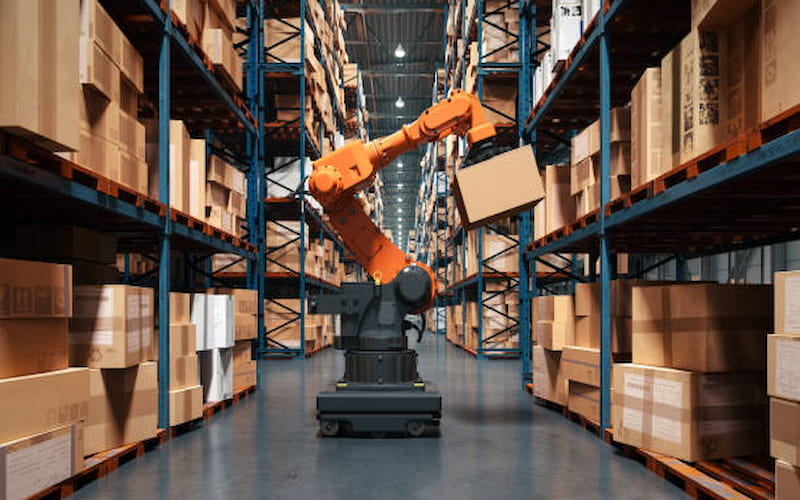
AI Is Reducing Tactical Work
AI is increasingly used for supplier research, spend classification, contract review, purchase order preparation, invoice matching, risk monitoring, and initial RFQ drafting.
Supply chain teams are also using AI to support demand forecasting, inventory planning, route optimisation, shipment visibility, and disruption management.
These tools reduce repetitive work but do not remove the need for human judgement in negotiation, supplier relationships, risk assessment, and strategic planning.
Sustainability Requires Better Supplier Data
Sustainability reporting is increasing the need for reliable supplier, material, production, and transportation information.
Procurement often collects supplier and product data, while SCM provides information about freight, warehousing, and distribution. Both functions must work together to improve value-chain visibility.
On July 3, 2026, the European Commission adopted revised European Sustainability Reporting Standards designed to simplify reporting while maintaining sustainability disclosure requirements for companies within scope.
Resilience Is Influencing Supplier Decisions
Businesses are placing greater emphasis on alternative suppliers, supply chain visibility, regional backup options, and closer supplier collaboration.
Deloitte’s 2025 Global Chief Procurement Officer Survey found that 74% of respondents considered maintaining active alternative sources an effective risk-mitigation strategy. Greater supply chain visibility and improved supplier information sharing were also leading priorities.
Procurement identifies and qualifies alternative suppliers. SCM determines whether those suppliers can support the required production, inventory, freight, and delivery plans.
Supplier Consolidation Requires Balance
Reducing unnecessary suppliers can simplify administration, improve purchasing leverage, and strengthen strategic relationships.
However, excessive consolidation may create dependency. Companies must balance supplier efficiency with continuity, geographic exposure, production capacity, and backup options.
For a clearer breakdown of responsibilities and decision-making, read our blog on building an effective procurement team.
Carbon Tracking Connects Procurement With Logistics
Factory location, materials, packaging, order quantities, freight modes, and delivery routes can all affect a product’s carbon footprint.
Procurement controls many upstream decisions, while SCM manages much of the physical movement. Accurate reporting therefore requires shared supplier, production, product, and transportation data.
Digital Platforms Are Becoming More Connected
Purchase orders, supplier confirmations, inspection results, production updates, shipment bookings, inventory records, and invoices increasingly need to move through connected systems.
This gives decision-makers a clearer view of how supplier pricing affects quality, freight, inventory, delivery, and total landed cost. For a broader explanation of the process, refer to our blog on business procurement.
Should You Hire a Procurement Professional or an SCM Professional?
| Business Priority | Procurement Professional | SCM Professional |
| Reduce supplier costs | Primary responsibility | Supporting input |
| Consolidate suppliers | Primary responsibility | Risk and capacity input |
| Improve contracts | Primary responsibility | Operational input |
| Vet Asian suppliers | Primary responsibility | Production input |
| Reduce lead times | Supplier negotiation support | Primary responsibility |
| Improve inventory | Supporting input | Primary responsibility |
| Manage demand planning | Limited involvement | Primary responsibility |
| Reduce freight costs | Commercial support | Primary responsibility |
| Manage distribution | Limited involvement | Primary responsibility |
| Improve customs compliance | Contract and Incoterms input | Primary responsibility |
| Manage supplier ESG data | Supplier contact | Operational verification |
| Manage returns | Supplier claim support | Primary responsibility |
Most growing international brands eventually need both capabilities.
Prioritise procurement when supplier pricing, contracts, sourcing, or quality are the main concerns. Prioritise SCM when inventory, production planning, freight, customs, or delivery performance require attention.
Smaller businesses may not need separate departments. One internal owner or external provider can coordinate both functions until order volume and operational complexity justify specialised teams.
When comparing procurement partners, examine whether each provider manages only supplier sourcing or can also support product development, production, quality control, warehousing, and logistics.
How Can UCT Asia Support Procurement and SCM?
UCT Asia supports product development, sourcing, production, quality assurance, fulfilment, and logistics across Asian manufacturing markets.
Its services include:
- Product design and prototyping
- Supplier identification
- RFQ and commercial negotiation
- Product and material sourcing
- Mass-production management
- Quality inspections
- Warehousing
- Pick-and-pack fulfilment
- Logistics coordination
- Custom promotional products
- On-pack marketing
- POSM
- Carbon footprint tracking
UCT Asia also supports industry-specific requirements, including branded merchandise, FMCG, hospitality, health and beauty, manufacturing, and oil and gas procurement.
The company’s three-phase process connects product development, sourcing, production, quality assurance, fulfilment, and delivery within one coordinated workflow.
Conclusion
Procurement determines what a company buys, who it buys from, and under which terms. Supply chain management ensures that the product is produced, stored, transported, and delivered effectively.
The two functions should share supplier data, production forecasts, quality requirements, cost information, inventory plans, and delivery schedules. Shared KPIs can also prevent one department from reducing costs in a way that creates problems elsewhere.
At UCT Asia, we coordinate sourcing, supplier management, product development, production, quality assurance, fulfilment, and logistics within one connected process. We help clients manage Asia-sourced products with clearer accountability from the initial brief through final delivery.
What Are the Most Common Questions About Procurement vs SCM?
Is Procurement Part of Supply Chain Management?
Yes. Procurement is one function within SCM. It focuses on acquiring goods and services, while SCM manages the wider flow through production, inventory, logistics, delivery, and returns.
What Is the Main Difference Between Procurement and SCM?
Procurement focuses on suppliers and purchasing terms. SCM focuses on the complete movement of products, information, and finances through the supply chain.
Why Are Procurement and SCM Separate in Some Companies?
The functions require different skills, systems, stakeholders, and KPIs. Larger businesses may separate them to create specialist expertise, while smaller businesses often combine them.
What Is the Salary Difference Between Procurement and SCM Roles?
Salary depends on the position, industry, location, and level of responsibility.
According to the U.S. Bureau of Labor Statistics, the median annual wage in May 2024 was $75,650 for buyers and purchasing agents, $139,510 for purchasing managers, $80,880 for logisticians, and $102,010 for transportation, storage, and distribution managers. These are occupational medians rather than guaranteed 2026 salaries.
What Is the Career Path for Procurement and SCM?
Procurement professionals may progress from Buyer or Procurement Specialist to Manager, Director, and Chief Procurement Officer.
SCM professionals may progress from Analyst or Planner to Manager, Director, Vice President, and Chief Supply Chain Officer.
How Does AI Affect Procurement and SCM?
Procurement AI supports sourcing, spend analysis, contract review, purchasing, and supplier monitoring.
SCM AI supports demand forecasting, production planning, inventory management, route optimisation, and shipment visibility.
Is Procurement a Good Career in 2026?
Yes. Procurement offers opportunities in commercial strategy, negotiation, supplier management, technology, sustainability, and risk.
Is Supply Chain Management a Good Career in 2026?
Yes. Supply chain professionals remain important across planning, manufacturing, logistics, inventory, technology, and risk management.
The U.S. Bureau of Labor Statistics projects employment for logisticians to grow 17% between 2024 and 2034, which is significantly faster than the average for all occupations.
What Is the Relationship Between Procurement and Logistics?
Procurement selects suppliers and agrees on commercial and delivery terms. Logistics manages the physical movement and storage of the goods.
The two overlap around Incoterms, packaging, freight requirements, supplier readiness, and delivery schedules.
Should a Small Business Separate Procurement From SCM?
Not necessarily. A smaller business may benefit from one person, team, or external partner managing both functions until supplier numbers, spending, inventory, and distribution become more complex.