
Behind every memorable dining experience is a team that looks the part. In the food and beverage industry, staff uniforms influence how guests perceive service, hygiene and brand quality from the first interaction.
For F&B brands competing across the Middle East and Asia, where hospitality is a strong cultural expectation, custom workwear is more than a back-office purchase. It is a visible brand investment that supports customer confidence, team identity and operational consistency.
This guide explains what F&B owners, hospitality marketing managers and operations directors should consider when planning custom workwear in 2026, from printing methods and fabric selection to supplier evaluation and uniform policy templates.
Why Does Custom Workwear Matter for F&B Brands?
Hospitality is one of the few industries where customers consume a product while interacting directly with the people who prepare and serve it. That proximity makes staff appearance an extension of food safety, brand quality and operational trust.
The business case is straightforward:
- Brand recognition: Consistent uniforms make staff easier to recognise and help establish a more memorable visual identity across customer touchpoints.
- Customer confidence: Clean, coordinated uniforms can reinforce perceptions of hygiene, professionalism and service standards.
- Team performance: Branded uniforms reduce uncertainty around what to wear while helping employees feel part of the brand.
- Operational efficiency: Purpose-built F&B workwear can include stain-resistant fabrics, reinforced seams and breathable panels to improve comfort and reduce frequent replacements.
For multi-location brands, custom workwear also supports visual consistency. A customer in Muscat should be able to walk into the same brand in Bangkok and immediately recognise the team.
What Types of F&B Workwear Should You Consider?
Different F&B formats require different uniform strategies. The right combination should reflect the venue, role requirements and customer experience you want to create.
| Uniform Type | Best For | Brand Signal | Typical Fabric |
| Chef Jackets | Kitchens, fine dining | Craft, authority, hierarchy | Cotton twill, poly-cotton |
| Aprons | Cafés, bars, casual dining | Approachable, modern, clean | Canvas, denim, waxed cotton |
| Front-of-House Shirts and Blouses | Service, hosts, managers | Polished, refined, consistent | Poplin, oxford, performance blends |
| Polos and T-Shirts | Quick-service and casual concepts | Friendly, energetic, relaxed | Piqué, jersey, moisture-wicking blends |
| Vests and Waistcoats | Fine dining and bartenders | Elevated, professional, detail-oriented | Wool blends, polyester |
| Caps, Beanies and Headwear | Open kitchens, bakeries and casual brands | Identity, hygiene, visibility | Cotton twill, mesh-back |
| Server Cloths and Accessories | Functional branding | Cohesion, premium feel | Branded cotton, leather accents |
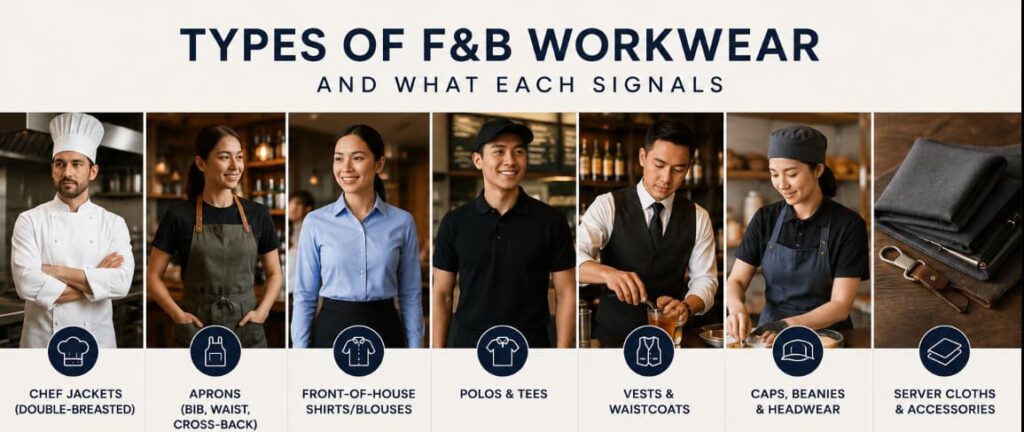
A modern F&B brand often combines three or four categories: a distinct kitchen uniform, a front-of-house top, an apron or service layer, and suitable headwear or accessories. This allows roles to remain visually distinct while keeping the overall brand cohesive.
Uniforms Make Role Differentiation Clear
In a busy restaurant, guests should be able to identify who can take an order, prepare food or recommend a wine pairing without needing to ask. Uniforms are one of the simplest ways to communicate that hierarchy while maintaining a polished appearance.
Which Printing Method Is Best for F&B Workwear?
Choosing the wrong decoration method is a common mistake when sourcing F&B uniforms. Each method has a place, but they are not interchangeable in an environment involving grease, sweat and frequent washing.
| Method | Durability | Best For | F&B Suitability |
| Embroidery | Excellent | Polos, jackets, caps and aprons | ★★★★★ |
| Screen Printing | Good | T-shirts and large graphics | ★★★★☆ |
| DTG(Direct To Garment) Printing | Fair | Complex artwork and small runs | ★★☆☆☆ |
| Heat Transfer or Vinyl | Fair | Names, numbers and small logos | ★★★☆☆ |
| Sublimation | Excellent | Full-coverage polyester garments | ★★★★☆ |
Embroidery Is Best for Durable, Premium Workwear
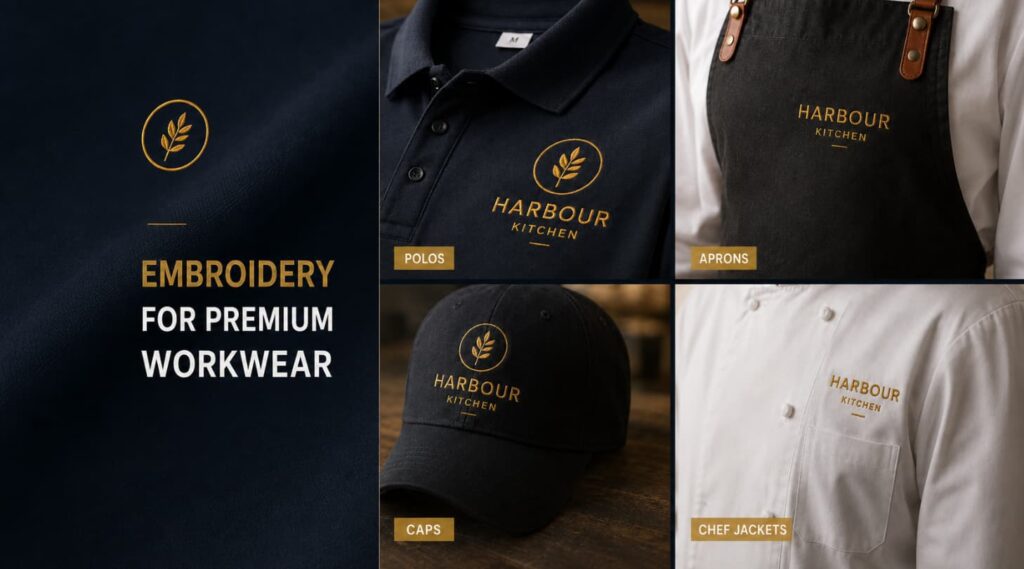
Embroidery is a strong choice for F&B uniforms because stitched logos can withstand regular laundering, do not crack or peel, and create a premium finish. It works particularly well for:
- Left-chest logos on polos and button-down shirts
- Caps and beanies
- Heavy fabrics such as aprons, chef jackets and outerwear
- Logos with one to four thread colours
Screen Printing Works Well for High-Volume T-Shirts
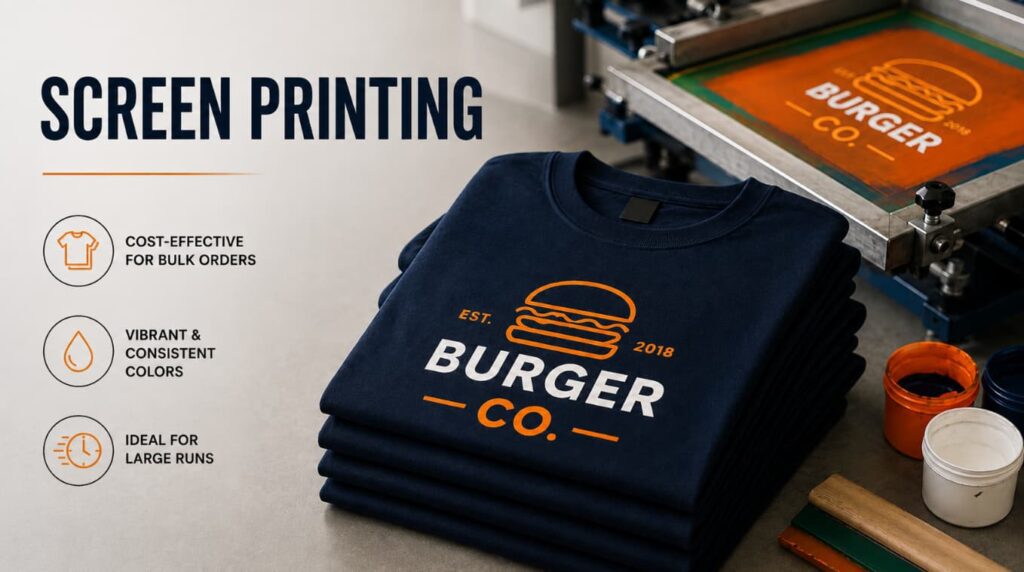
Screen printing is often more cost-effective for cotton T-shirts and larger graphics. It is well suited to:
- Back prints on staff T-shirts
- Promotional T-shirts sold to customers
- Large logo placements
- High-volume uniform runs
DTG Is Less Suitable for High-Wear F&B Uniforms
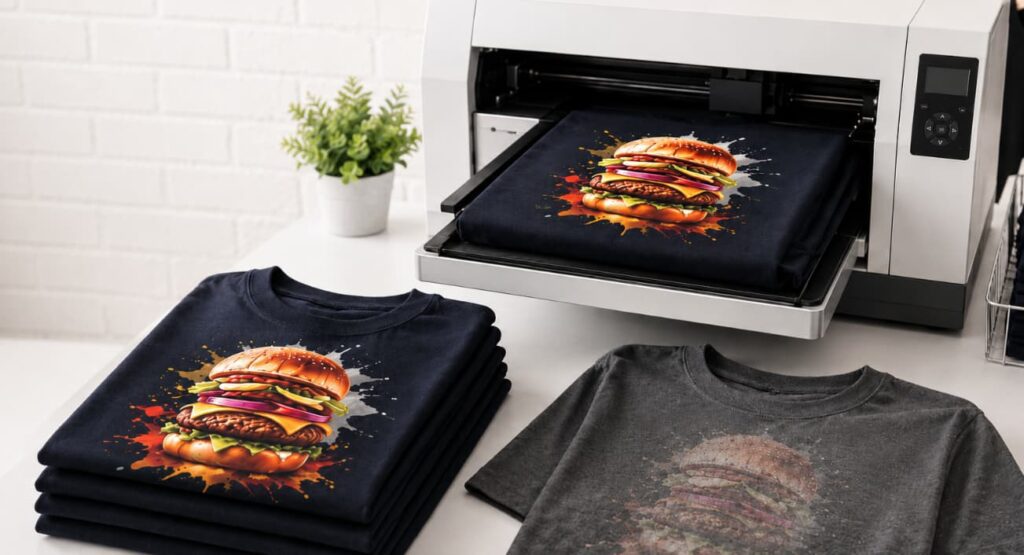
DTG printing can create detailed, full-colour designs, but it may not be the best choice for back-of-house uniforms that require frequent commercial laundering. It is generally better suited to short runs, promotional apparel or lower-wear garments.
What F&B-Specific Workwear Features Should You Prioritise?
Generic promotional apparel may not perform well in food and beverage environments. F&B workwear should be selected with hygiene, comfort, safety and longevity in mind.
Hygiene and Food Safety Requirements
- Colour choice: Dark colours can hide stains, while mid-tone heathers and subtle patterns can offer a practical balance between appearance and maintenance.
- Apron coverage: Bib aprons can help protect clothing from splashes and spills while creating a clean, professional visual layer.
- Hair restraint: Caps, headbands and bandanas can support food-handling hygiene requirements and reinforce brand identity.
Breathable Fabrics Improve Staff Comfort
Kitchen and service teams often work long shifts in warm conditions. Breathable fabrics, moisture-wicking finishes and flexible cuts can make a significant difference to staff comfort.
- Breathable fabrics: Performance blends can help staff stay more comfortable in hot kitchens and outdoor service areas.
- Room for movement: Uniforms should allow employees to bend, lift and move quickly without feeling restrictive.
- Flexible layers: Teams moving between kitchens, dining rooms and outdoor spaces benefit from layers that can be added or removed without disrupting the uniform standard.
Durable Construction Reduces Replacement Costs
- Industrial wash testing: Ask suppliers how garments perform after repeated commercial wash cycles.
- Reinforced seams: Bartender vests, server aprons and chef jackets should have durable stitching at high-stress points.
- Stain-resistant finishes: Treated fabrics can help uniforms stay presentable for longer and simplify daily maintenance.
How Should You Plan a Custom Workwear Budget?
Many F&B operators underestimate how quickly uniform requirements can scale. A 50-seat restaurant may need multiple uniform sets per staff member to account for laundry, rotation and replacements. Multi-location brands may require hundreds of pieces for a single refresh cycle.
Pricing depends on garment quality, decoration method, order volume, fabric, custom trims and shipping requirements. Polos with embroidery generally cost less than heavier aprons or chef jackets, while caps and standard T-shirts are usually lower-cost items.
A practical budget should account for at least two to three items per staff member for each required role, plus replacement stock for new hires and damaged garments.
Use Quantity Breaks Strategically
- Combine locations: Multi-venue operators can consolidate orders to improve unit pricing and standardise branding.
- Phase rollouts: Test fit, fabric and decoration at one location before committing to a larger order.
- Plan refresh cycles: High-wear items such as aprons and chef jackets may require replacement sooner than polos or outerwear.
How Can You Design Workwear for Stronger Brand Impact?
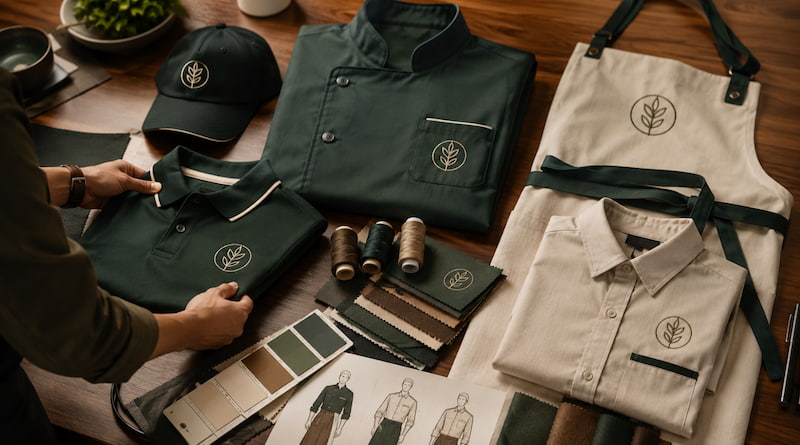
A logo embroidered on a polo does not automatically create a uniform programme. The strongest F&B workwear reflects the venue’s personality, service style and visual identity.
- Keep logo placement consistent: Left-chest placement is widely used, while sleeve or back-yoke branding can add visibility without overwhelming the garment.
- Limit the colour palette: Two or three brand colours are usually enough to create a consistent and recognisable uniform programme.
- Match the venue: Fine-dining uniforms should reflect a different visual standard from quick-service or casual dining concepts.
- Make names visible where suitable: First names on a chest area or apron can create a more personal service interaction.
- Design inclusively: Consider diverse body types, religious dress requirements and different employee preferences from the start.
For more ways to connect physical products with brand visibility, explore our guide on using marketing merchandise to boost brand awareness
How Do You Choose a Workwear Supplier in the Middle East and Asia?
The supplier landscape for custom workwear is varied. Local decorators can offer speed and convenience, while regional manufacturers may provide greater garment choice, customisation and production capacity. The right choice depends on order quantity, required lead time and the complexity of your programme.
Supplier Evaluation Checklist
- Is decoration completed in-house or outsourced?
- Can the supplier provide a pre-production sample for approval?
- Are garment fabrics and sourcing details clearly explained?
- Does the supplier have experience with F&B, hospitality or corporate workwear?
- Can they provide relevant examples of previous work?
- Is pricing clearly broken down by garment, decoration and setup?
- Can they scale from a small pilot order to a larger multi-location rollout?
- Do they offer quality control, packing, fulfilment or logistics support?
For buyers in Oman, the UAE and Saudi Arabia, working with a regional sourcing partner can simplify communication, quality assurance and delivery coordination. UCT Asia provides design, sourcing, production, quality assurance and fulfilment support for branded merchandise programmes, including corporate workwear and hospitality-related items.
For larger programmes, understanding quality assurance, fulfilment and logistics can help reduce delivery and consistency issues.
What Should a Restaurant Uniform Policy Include?
A uniform programme without a written policy can quickly become inconsistent. Use the following framework as a starting point for your own workplace policy.
Scope
This policy applies to all front-of-house and back-of-house staff at [Venue Name].
Provided Items
Each team member is issued:
- Three branded polos or shirts
- Two aprons, where applicable
- One headwear item
- One seasonal outerwear item
Replacement Schedule
- Polos: Replaced every 18 months or as needed
- Aprons: Replaced every 12 months or as needed
- Outerwear: Replaced every 24 months or as needed
Standards
All uniform items must be clean, wrinkle-free and in good repair at the start of every shift.
Personal modifications, such as cutting sleeves or adding patches, are not permitted.
Religious dress accommodations, including branded hijabs or headscarves, should be available in suitable brand colours where required.
Loss and Damage
Lost or damaged items outside normal wear may be replaced at the employee’s cost, depending on company policy.
Return on Separation
All issued items must be returned on the employee’s final day of employment.
Conclusion: How Can Workwear Become a Brand Asset?
In F&B, your staff are a visible part of the brand experience. The right custom workwear programme helps every server, host and chef present a consistent, professional image throughout the day, across every customer interaction.
At UCT Asia, we help F&B brands approach gift merchandise procurement as part of a broader brand strategy, not simply as a purchasing task. From custom workwear and serving materials to branded promotional products, we support businesses with design, sourcing, quality assurance and logistics to help create practical, durable and recognisable brand assets.
FAQ
What Is the Best Printing Method for Restaurant Uniforms?
For many F&B applications, embroidery is a strong long-term option. It withstands regular laundering, looks professional and works well on polos, aprons, caps and chef jackets. Screen printing can be more cost-effective for cotton T-shirts and large back prints.
How Much Do Custom Restaurant Uniforms Cost?
Costs vary depending on the garment, decoration method, fabric quality, quantity and level of customisation. Polo shirts and caps are usually lower-cost items, while chef jackets, heavier aprons and fully custom garments require a larger budget.
How Many Custom Uniforms Should I Order?
A practical starting point is two to three pieces per staff member for each role category. This allows one item to be worn, one to be washed and one to remain available as a backup.
What Is the Most Hygienic Fabric for F&B Uniforms?
Polyester-cotton blends with stain-release finishes are often selected for their balance of durability, comfort and washability. For kitchen teams in warmer climates, moisture-wicking performance fabrics may offer better comfort than 100% cotton.
Can I Customise Existing Uniforms Instead of Starting From Scratch?
Yes. Embroidery, screen printing and heat transfer can be applied to many stock garments. However, custom fabric colours, patterns, trims, labels and garment shapes require custom manufacturing.
How Long Does a Custom Uniform Order Take to Deliver?
Lead times depend on the supplier, order size and level of customisation. Decorated stock garments may be completed more quickly, while fully custom-manufactured uniforms require additional time for sampling, production and shipping.
Where Can I Source Custom Workwear in the Middle East?
Regional suppliers and sourcing partners with production capabilities in Asia can provide a balance of quality, pricing and delivery support. Look for suppliers with hospitality experience, transparent minimum order quantities and reliable quality control processes.
Are There Minimum Order Quantities for Custom Workwear?
Most suppliers have minimum order quantities for decorated stock garments and higher requirements for fully custom uniforms. The exact quantity depends on the decoration method, fabric, style and level of customisation.
How Should I Handle Uniforms for Staff Who Wear Hijab or Other Religious Dress?
An inclusive F&B uniform programme should include suitable long-sleeve options, modest cuts, branded hijabs or headscarves, and flexible sizing. These options should be incorporated into the standard uniform policy rather than treated as exceptions.
What Is the Difference Between Custom Workwear and Promotional Apparel?
Promotional apparel is often designed for campaigns, events or giveaways. Custom workwear is designed for repeated use in a professional environment, with greater attention to fit, durability, washability and role-specific requirements.
How Can I Measure ROI on a Custom Uniform Programme?
Track staff feedback, replacement frequency, customer satisfaction comments and brand consistency across locations. These indicators can help show whether the programme improves staff comfort, operational standards and customer perception.
Can Custom Uniforms Be Sustainable?
Yes. Many suppliers offer recycled polyester, organic cotton and lower-impact dyeing options. Sustainable fabrics may cost more, but they can support a brand’s environmental commitments and help reduce the impact of frequent uniform replacement.